Dust obscures your vision in all directions. Only a slight drop in temperature warned you of the storm's coming, but you're in it now. You can't see anything, and breathing becomes more difficult as grit whips into your nose and mouth. You cough, retch, but then you start to hear deep voices shouting over the rush of debris. They're coming from the south, or what you think is south, but you don't make out their feathered bodies until they're on you. One reaches you, lifts its foot to rest upon your shoulder, and forces you down to the ground along side it. Its weight is comforting, and you close your eyes and focus on breathing, difficult as it may be, until the storm starts to clear.
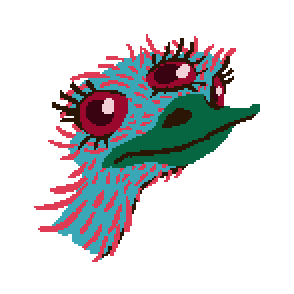
Wingless descendants of flying mammiles, rarites are tall bipedal mammiles covered with shaggy feathers, with colors depending on the season, and have long, flexible tails. Their feet are their hands, and they have six digits on each with two opposable thumbs. Large primary eyes help them see across vast distances, but their third eye helps them detect more colors in their UV-bright world, and all are well-adapted for the dusty grasslands that make up the rarite homeland. Every year during mating season, their skin goes from gray to cherry red or cobalt blue, contrasting against their green summer plumage.
Senses
Vision
Rarites have three eyes. Two, large trichromatic eyes sit above the beak, offering great distance vision with a color range similar to humans, while the smaller third eye sits between the other two and is much simpler. The third eye has two photoreceptors for color vision within the ultraviolet spectrum, but it has very low resolution, so UV colors are perceived as softer and blurrier.
For protection against dust, all three eyes have a translucent nictitating membrane and long eyelashes.
Hearing
Rarites don't have an external ear, but they have large eardrums attuned to low frequencies.
Chemosensory system
Like the other sophont species on Mutania and snakes, lizards, and some mammals on Earth, rarites have a vomeronasal organ (VNO), also known as a Jacobson's organ. It detects close-range chemical signals like pheromones. Rarites can use these signals to detect reproductive status, emotional state, or sickness in other rarites. Rarites can pick up signals from other sophonts, but what the signals mean has to be learned like a language rather an innate biological understanding.
Whiskers
On their faces, they have whiskers at the base of their beaks and above their primary eyes. As bipedal animals, their whiskers are primarily used for social touch and communication.
Speech
Rarites have a larynx like a mammal rather than a syrinx. Their larynx sits at the top of the long tracheal tube. They have textured beak interiors and flexible tongues for precise articulation, but their voices are deep and resonant, similar to a didgeridoo.
Skin and feathers
Rarites are covered in shaggy feathers. Only their wrists, hands, and end of tails are bare, exposing gray skin. During the spring and summer, their plumage is light green with diffuse yellow and gray mottling, but they molt new brown-gray feathers with black mottling during the winter. The feathers on their necks, heads, and tail are much shorter than the feathers on the rest of their body.
Hormone changes during breeding season coincide with drastic skin coloration in both sexes. Females' skin turns blue as increased estradiol in their systems causes collagen fiber changes, and males' skin turns bright red as more testosterone fuels improved conversion of dietary carotenoids to red skin pigment. The vividity of the red is dependent on overall health and diet.
Respiratory system
Respiration is driven by a diaphragm, a muscle that contracts to pull in air and relaxes to expel it. Lungs inflate and deflate, unlike teronura or Earth bird lungs which remain rigid.
Digestive system
They have flat, wide, and short cream-colored beaks and lack teeth. They have a second stomach filled with rocks and grit that pulverizes and "chews" food that they swallowed whole and began chemically processing in the first stomach. The gizzard must be replenished often, so rarites have to maintain a steady amount of grit as part of their diet.
At the junction of their small and large intestine, rarites have ceca (sing. cecum), offshoots of the main intestinal tract, which ferment plant material and produce fatty acids and B vitamins. Bacteria in the ceca breaks down cellulose, like the kind found in grasses. Exact diet varies by culture and individual, but evolutionary ancestors ate grasses, leaves, shrubs, flowers, bulbs, and grains for the bulk of their diet, with occasional fruits, legumes, insects, and small mammiles and their eggs making up the rest.
Musculoskeletal system
They have marrow-filled bones like non-flying mammiles.
Limbs
Rarites have two legs and a tail. Their tails are long, flexible, and strong enough to help serve as an additional tripod leg to balance on when using their feet/hands for object manipulation. However, they can only use one hand at a time, given that the other must be used to stand. When it's not being used for balance, the tail is held aloft.
Their hands have six digits with two opposable thumbs, one on either side of the palm. They walk on their hands palm-down with four fingers touching the ground and the two thumbs elevated slightly.
Distant evolutionary ancestors of rarites had wings, but they've become vestigial, and only small nubs tucked amongst their feathers remain.
Reproductive system and life cycle
Rarites have a mating season that lasts about 4 months starts in late spring and ends in late summer, although the boundary is fuzzier for rarites living in more tropical climates. A few weeks after the mating season starts, there is a strong peak about 2 weeks long where hormones and the urge to mate are at their highest. A smaller echo of this peak occurs about 2 months later, a holdover from evolutionary ancestors' response to failed egg clutches.
Outside of the mating season period, their primary sexual organs are shrunken/regressed and dormant. Males have a solid collagenous phallus that is held inside the body until needed. Females have two ovaries and oviducts, although the left one is larger, and the vagina opens into the cloaca.
On average, a female rarite lays about 7-11 eggs per season. Communal nesting was the norm for rarite evolutionary ancestors, but exactly how nests are maintained in the current Mutania time period varies across cultures. Both sexes have brood patches that shed feathers during nesting season, allowing anyone to incubate eggs by sitting on them. Eggs take about 70 days to incubate.
Chicks are capable of walking a few hours after hatching. Right before they hatch, the young absorb the last of the yolk into their abdomen, then they draw on that for nutrition and energy for their first week out of the shell before they need to eat new foods and swallow grit.
Rarites take about 18 months to reach their full size, but they grow in spurts rather than continual growth. They're only reproductively mature at about 8 years old.