- singular: ildoar; plural: ildoar
- Name origin: from "wild boar"
- Lifespan: 60–70 years
- Average height: 4'–4.5' (1.22–1.35m)
- Average weight: 440–880 lbs (200–400 kg)
- Diet: Omnivorous hypocarnivores
- Dental formula: 4 premaxilla (including incisors and tusks) and 13 maxilla molars (upper jaw)/18 dentary (lower jaw)
Ildoar
the Star-Nosed
You hear them first. Songs overlap and harmonize in the forest just beyond the grassy road where you've been hiking. Bells, drums, and resonant voices call out as the noon sun hangs pendulously overhead. Approaching the noise brings you closer to wooden fences and clustered houses full of people with green noses who extend their arms in silent greeting—although you can't be sure they're truly looking at you—while the songs continue. At last, you hear an instrument that doesn't exist ring out, and the songs collapse into daily life and babbling speech.
Ildoar have digitigrade feet and a long tail for counterbalancing their forward-leaning bipedal stance. They are fuzzy everywhere besides their palms and soles, and their necks are very fluffy. Their long snouts end in a "star-shaped" nose that's green with stolen chloroplasts from consumed plant material. Tusks on their upper jaw stick out of their mouth even when it's closed. Unique eyes allow them to look in four directions at once at the same time. Complex songs and vocal mimicry are accomplished with the help of a well-developed syrinx.
Facial anatomy
Star-shaped nose
Ildoar have "star-shaped" noses on the end of their snouts with 18 tiny appendages that extend radially from the nostrils. When ildoar eat certain species of plants, chloroplasts from those plants are absorbed into the nose, making it bright green and capable of minimal photosynthesis. The star-shape allows for increased surface area to capture more light. Greener noses are a sign of a plant-rich diet, but "normal" ranges of green vary by individual.
Teeth
Ildoar teeth, even their tusks, shed continuously. Replacement teeth grow inside and then push out the old teeth, and most teeth are replaced once or twice a year, but more often when young ildoar are growing to their full size. Tusks take up to three years before fully replacing the old ones. Every time new tusks grow, they're bigger than the previous set. Older individuals shed teeth less often.
Most of their teeth are simple and cone-shaped, and some are visible even when the mouth is closed.
Senses
Vision
Ildoar have two sets of eyes, and they're some of the strangest eyeballs on Mutania. A ring of tiny bone plates embedded in the sclera forms a cone for each eyeball to sit in, while a fused eyelid covers most of the eyeball except for the pupil. Unlike most mammiles, their eyes feature a negative (concave) lens and a positive (convex) cornea. By manipulating their cornea and rotating their eye in the socket, they only need one eye to perceive depth.
Their eyes move independently of each other most of the time, but they can coordinate their gazes, too. Each eye has a range of movement about 180° horizontal and 90° vertical.
Because the eyelid is fused, they don't really blink. Instead, they use a translucent nictitating membrane to clean their eyes. They do still close their eyes when sleeping, although this is achieved by retracting the eyeball deeper into the cone it sits in so the lid closes into a narrow slit.
The set of eyes closer to the tip of their snouts are smaller than the other. The smaller eyes have a lower resolution and are worse in low-light conditions, but they can rotate and scan more quickly than the larger eyes.
All four eyes have tetrachromatic vision that includes the ultraviolet spectrum.
Hearing
Ildoar have adaptations for hearing a wide range of sounds with a slight bias towards low frequency sounds, like other sophonts on Mutania.
Chemosensory system
Ildoar have a weak sense of smell, but they can taste sweet, umami, bitter, salty, and sour.
Like the other sophont species on Mutania and snakes, lizards, and some mammals on Earth, ildoar have a vomeronasal organ (VNO), also known as a Jacobson's organ. It detects close-range chemical signals like pheromones. Ildoar can use these signals to detect reproductive status, emotional state, or sickness in other ildoar. Signals output from other sophonts can be detected, but what the signals mean has to be learned like a language.
Speech
Ildoar possess a syrinx-like structure located where the trachea branches toward each lung. Cartilaginous rings modulate vibrations as air passes through, and each branch can modulate different sounds simultaneously. Their flexible tongues add further depth and control over their voices. Vocal performance was a sexually selected trait among ildoar evolutionary ancestors, so they are very capable of memorizing and performing vocal pieces of various lengths and complexities, including mimicry.
Integumentary system
Filaments called pycnofibers cover the majority of their bodies, with scales present on their palms and soles. Pycnofibers are similar to hair, but their exact shape varies. Ildoar necks are especially fluffy because the pycnofibers there branch at the end like dandelion seeds, but most pycnofibers are very short (less than 1 cm long) and simple. Under the pycnofibers, their skin is dark brown.
Patterns in the pycnofibers vary. All ildoar carry a specific gene for encoding different patterns, but it's not active in all. Coats can be solid brown of various shades or spotted/striped with white, cream, or orange. Spot size/shape or stripe pattern runs in families but varies between populations.
Digestive system
Ildoar rely on chloroplasts from plant matter that they consume for their noses to retain their healthy green color. They have a forestomach, a pouch after the esophagus but before their monogastric acid-secreting stomach, lined with special cells that detect and extract live chloroplasts to send them toward the nose before the normal digestive process destroys them. After the stomach is a gizzard full of rocks that can be used to pulverize difficult material. Ildoar have to swallow grit regularly to maintain their digestive systems.
Evolutionary ancestors of the ildoar ate primarily whatever they could dig out of the ground, including roots, tubers, and grubs, but meat, eggs, fruit, leafy greens, fungi, and fully-grown invertebrates were also part of their diet. Their large intestine has a large offshoot called a cecum that holds foods that require fermentation for them to fully digest, like leaves and grasses.
Respiratory system
Ildoar have a unidirectional respiratory system with lungs and a series of air sacs (three pairs and one unpaired). Their full breath cycle requires two instances of inhalation and exhalation as air moves from the trachea, posterior air sacs, lungs (where gas exchange takes place), anterior air sacs, and then out again. This system allows them to speak/sing for long periods of time without needing to pause for a breath.
Reproductive system and lifecycle
Ildoar have three sexes. Two directly contribute genetically to offspring while a third carrier sex is required for the embryo to develop. A single large egg cell complete with yolk is donated by one sex into the carrier via an ovipositor, and sperm cells are donated via a penis by the other. The carrier sex can store sperm in their body for up to eight days, but egg cells must be fertilized quickly or else they'll die and be shed from the body.
The ovipositor and penis are inserted into an organ in the carrier sex accessible via the cloaca that is similar to a vagina, leading to the equivalent of an oviduct. It is a long reproductive tract where at the far end there is an infundibulum where fertilization actually takes place, then the egg develops over 21 days before it's laid.
After laying, the egg takes about 40 days of incubation (done via brood patches on ildoar bellies) before hatching. Freshly-hatched ildoar have fully functioning eyes and a layer of very fluffy pycnofibers that will molt a few months later. They can walk a few days after hatching.
An important element of early development is vocal tutoring. Young ildoar have to be exposed to adults who can teach them how to use their impressive vocal abilities. Without this exposure, ildoar singing ability is severely limited, even though their actual syrinxes work correctly.
Ildoar reach full size at about 10 years old and reproductive maturity at about 15.

Art by cyrsed
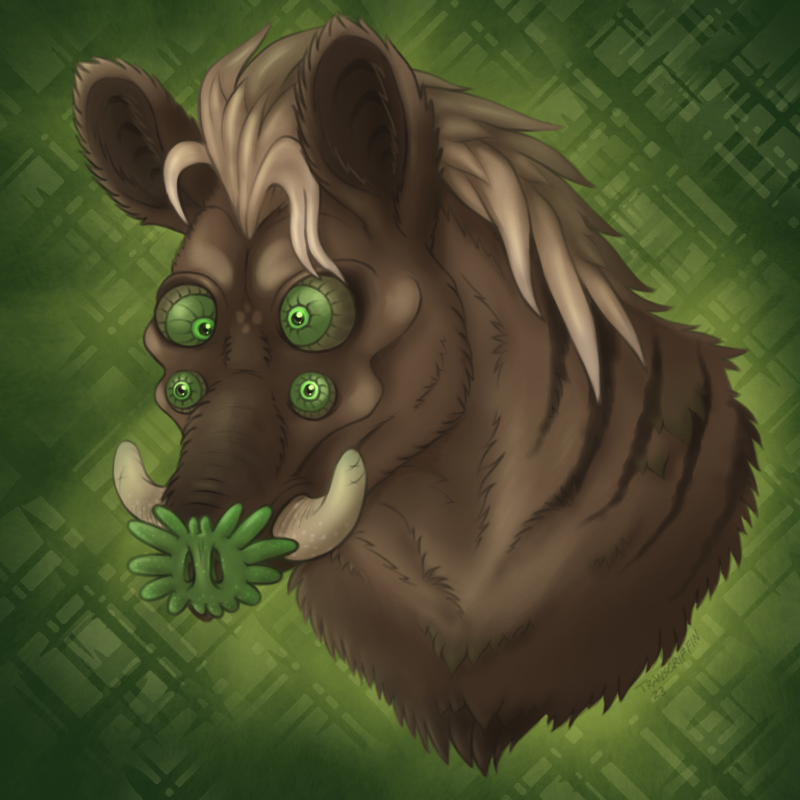
Art by Transgriffin