Nuztû (rellow) colors
- Red: uŝk /uʃk/
- Orange/brown: înso /ɪnˈsɔ/ (related to the word for nut or seed)
- Yellow: yays /jajs/ (related to the word for grass)
Teŝda (tesh-DAH) is part of the Teŝpen language family. Languages derived from Teŝpen are notable for their individualized and collective approach to pronouns, color-based noun classes, and agglutination.
Teŝda is spoken by Kugma and Iati people who understand any given singular body to be full of multiple individual entities. Common expressions and everyday conversations involve frequent mixing of singular and collective first person pronouns. The language also marks for clusivity, making it clear whether "we" means "everyone" or "only everyone in the body family."
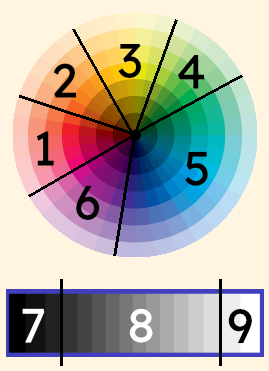
There are three important color groups that also function as noun classes. The groups divide the color wheel into three parts: nuztû for red and yellow (rellow), ad for green, blue, and purple/pink (cool), and irn for black, white, and gray (monochrome). Color class words are infixes between number markers and stem nouns, except nuztû is abbreviated nuz. When color class markers are used for pronouns, they are suffixes.
The word for gray is also used as a descriptor for a color's saturation (a "gray" yellow is a desaturated yellow), and the words for black and white can be used to describe the relative darkness of the color ("black" blue is darker than "white" blue).
People create their own pronouns using pronoun prefixes and a noun or adjective. When talking about someone whose pronouns are unknown the speaker, they use a special set of pronouns without a personalized suffix. In the third person, pronouns used to refer to things that aren't people also don't use personalized suffixes.
Pronouns are considered a form of individual expression and can function like second names. Common choices for suffixes are colors and animals. Because colors are gendered, color suffixes are associated with certain genders. Animals belong in color noun classes, so they too have a gender, but they're more specific terms. Occasionally, people use their name as a suffix or don't use a suffix at all, using just the pronoun prefix.
Personalized pronouns are handy when multiple entities in a body family are speaking at the same time. With multiple "I"s speaking, using different suffixes helps everyone understand who's the speaker.
There is said to be a mountain family "for each mountain in the Kugma mountains." Individuals in a mountain family do not necessarily have a tie to the location, but it refers to the lineage traced through the egg-laying parent's side.
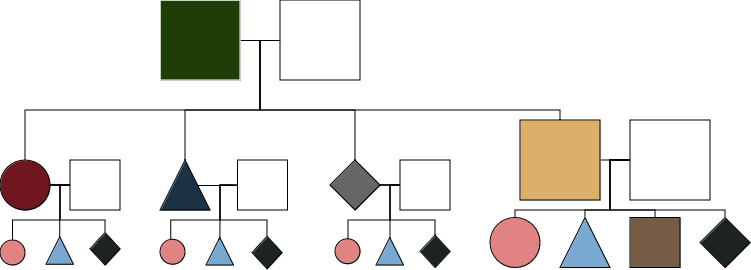
Kinship terms are based on gender and age, with unique terms used for the egg-laying parent and the egg-laying parent's own egg-laying parent. There are gendered terms for siblings, and all cousins from the egg-laying parent's side are also considered siblings. Uncle/aunt relationships are only traced on the egg-laying parent's side and have gendered terms.
Shapes with the same color use the same term. The brown square is the person whose family tree this is.
Teŝpen, the language Teŝda evolved from, used a horizontal line to indicate word breaks and a vertical line for sentence breaks. Over time, this developed into the symbols in the Teŝda abugida writing system having special forms when they appear at the end of a word.
Sentence breaks are still denoted with a vertical line, but as the primary writing method switched from engraving in clay to ink and paint on parchment, people began to emphasize the sentence breaks with more flourishes. Doodlers might end up with a final sentence in their notes that has a final line decorated to look like a gorgeous tree with many branches or to look like the leg of a furry animal.
There are three grammatical numbers in Teŝda: singular, plural, and collective. The collective number is used to describe a group of something, such as describing an entire herd or an entire body family, and is marked with the bû- prefix, derived from the Teŝpen word for the body family.
Teŝda uses a base 6 numbering system. For very large numbers, a base 36 numbering system is used instead.
Consonant inventory: b d f g j k l m n p r s t v z ʃ ʒ
| ↓Manner/Place→ | Bilabial | Labiodental | Alveolar | Palato-alveolar | Palatal | Velar |
|---|---|---|---|---|---|---|
| Nasal | m | n | ||||
| Stop | b p | d t | g k | |||
| Fricative | f v | s z | ʃ ʒ | |||
| Approximant | j | |||||
| Trill | r | |||||
| Lateral approximant | l |
Vowel inventory: i u a ɔ ɛ ɪ ʌ
| ↓Height/Place→ | Front | Back |
|---|---|---|
| High | i | u |
| Near-high | ɪ | |
| Low-mid | ɛ | ʌ ɔ |
| Low | a |
Syllable structure: (C)(r or l if first C is not nasal)V(n)(C)(C except fricative if previous C was a fricative)
Stress pattern: Ultimate — stress is on the last syllable
Spelling rules:
Circumflexes over vowels indicate lower height. Circumflexes over consonants indicate palato-alveolar.
| Pronunciation | Spelling |
|---|---|
| ɪ | î |
| ɛ | e |
| ʌ | û |
| ɔ | o |
| ʒ | ẑ |
| ʃ | ŝ |
| j | y |