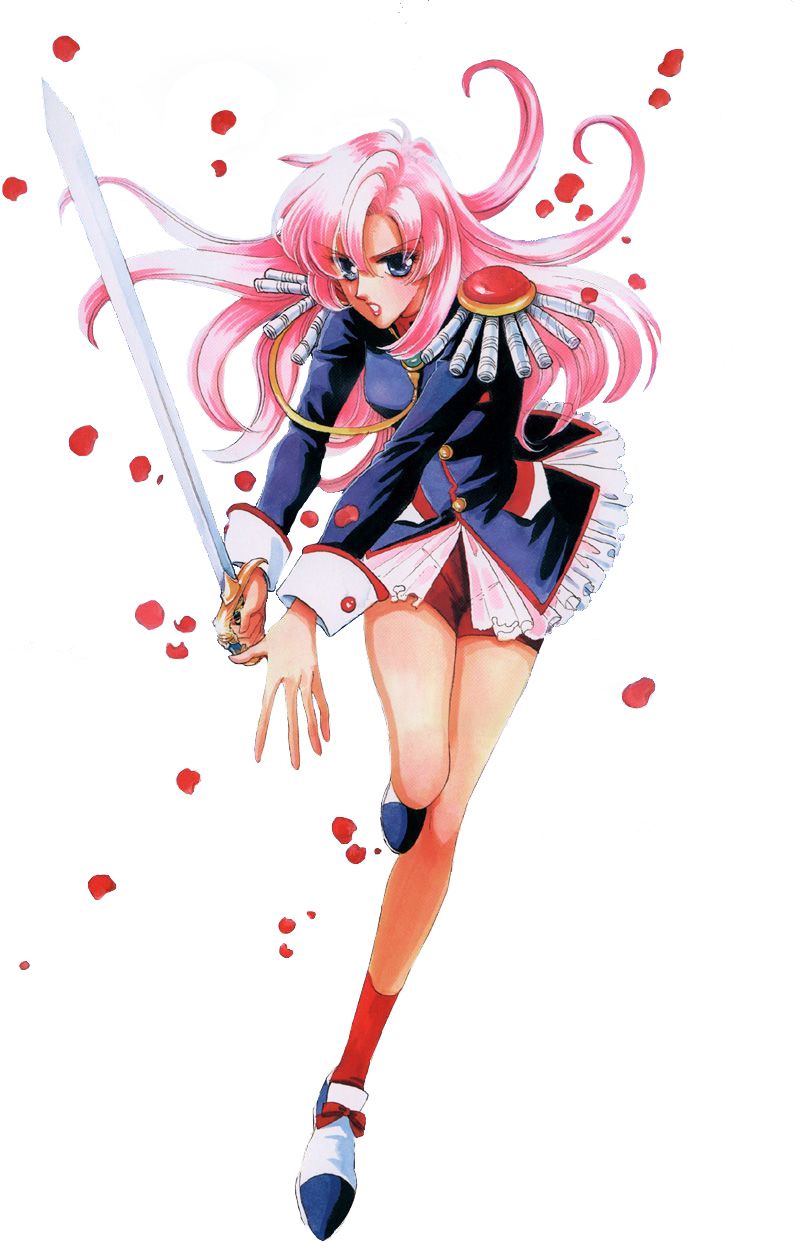
Revolutionary Girl Utena
Revolutionary Girl Utena tells the story of Utena, a middle school girl, who becomes involved in a series of duels to possess the Rose Bride, fellow middle school student Anthy Himemiya. Utena was given a rose crest ring as a child by a prince who promised that the ring would lead her to him, and she was so inspired by his kindness and chivalry that she desires to become a prince herself.
Her sense of justice drives her to challenge a fellow student to a fight after witnessing his cruelty to others. Little did she know, he was a duelist appointed by the End of the World to fight to win Anthy, granting him the power to "revolutionize the world." When Utena wins the duel and becomes engaged to the Rose Bride, she must defend her place against challengers to keep Anthy away from people who would use her to their advantage.
But also, maybe, revolutionize the world while she's at it.
The contents of this shrine are a bit scattered, from high-level descriptions of characters, plot, and production; to our thoughts on major themes; and to our experience playing the RGU video game. At the very bottom are links to the source material and fan-generated content. Use the mini-nav at the top if you want to skip to different sections.
And play the music, if you like. :)

Narrative
The main characters are Utena Tenjou and Anthy Himemiya. The development of their relationship is the foundational element that persists across all versions of the story.
Utena wants to be a prince. Anthy has fallen into her lap as the perfect princess. But is being a prince really such a good idea?
-
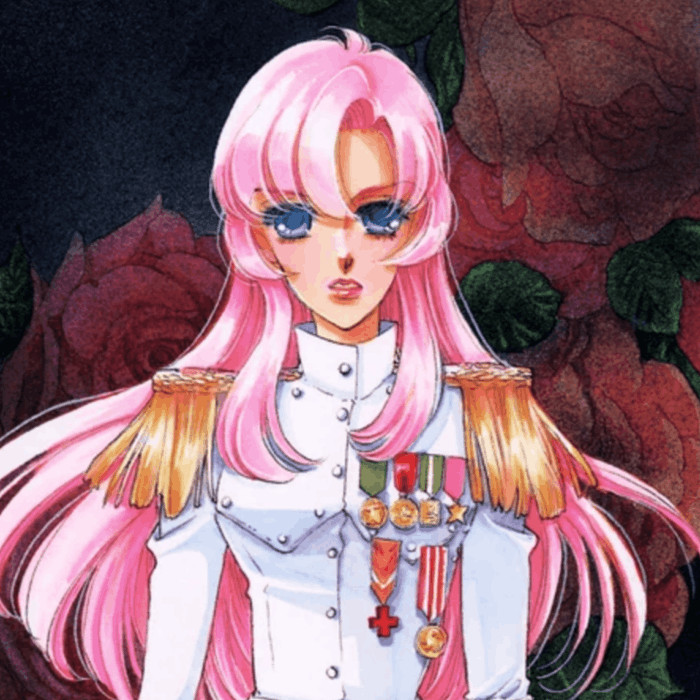
Utena Tenjou
The Prince
-
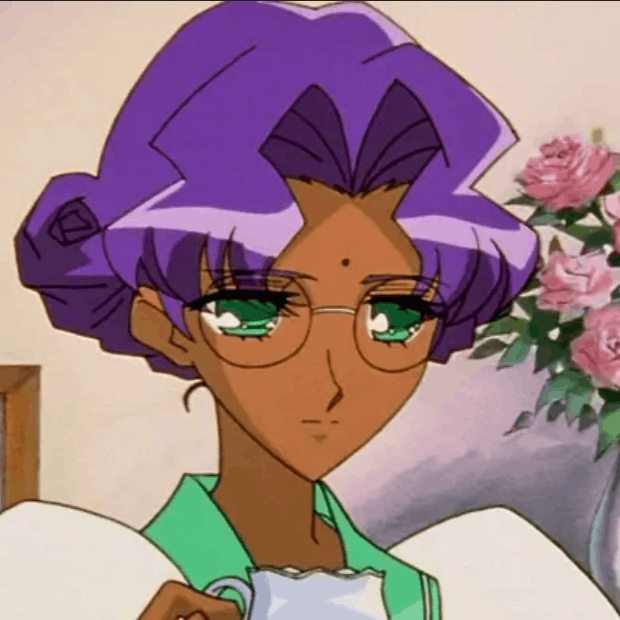
Anthy Himemiya
The Rose Bride
Rules of the Duels
A hunched forest crouches at the edge of the academy, and the door to enter it is locked to anyone who doesn't possess a rose crest ring. After the door opens to the select few, a competitor ascends a winding staircase to the arena in the sky. Above them, an upside down castle looms like a magnificant chandelier above the competitors as they duel.
Each duelist has a rose placed in their left breast pocket by the Rose Bride. The duelists draw their swords, and whoever cuts the other's rose off wins the duel.
The duelist engaged to the Rose Bride can conjure the sword of Dios, an enigmatic source of extraordinary power.
Student Council
The members of the Student Council possess rose crest rings and have been tasked by the End of the World to duel over the Rose Bride. Each has their thoughts about the promised reward and what they're willing to do to achieve it.
Their duels with Utena make up the first arc of the story.
-
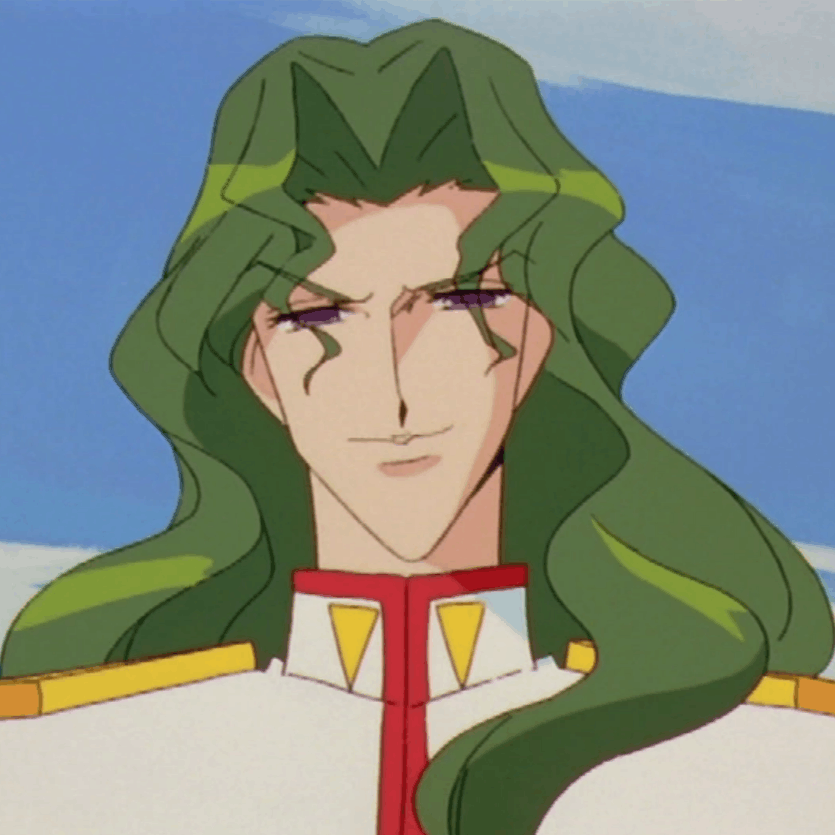
Kyouichi Saionji
Vice President and Kendo Captain
-
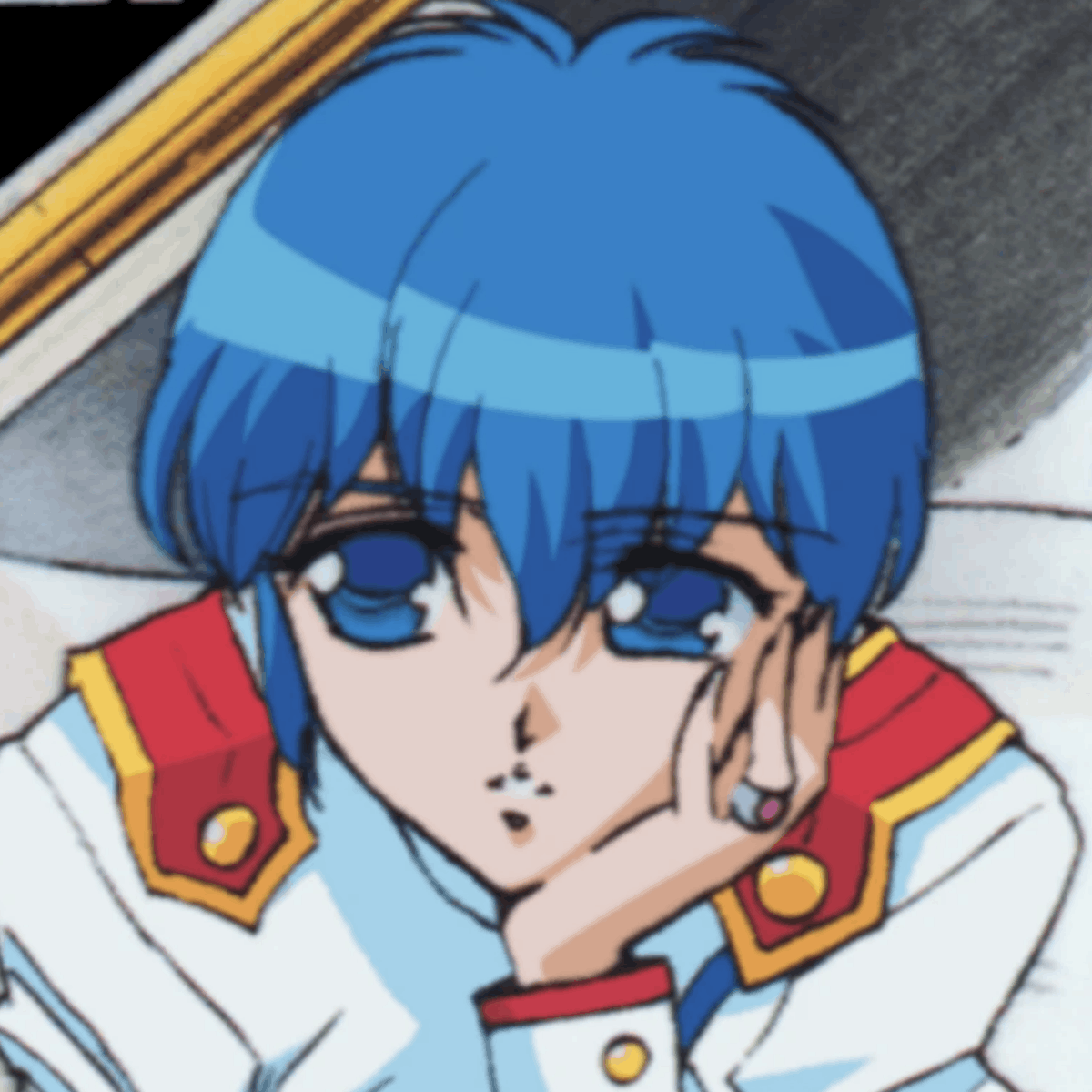
Miki Kaoru
Pianist, Fencing, and Academic Prodigy
-
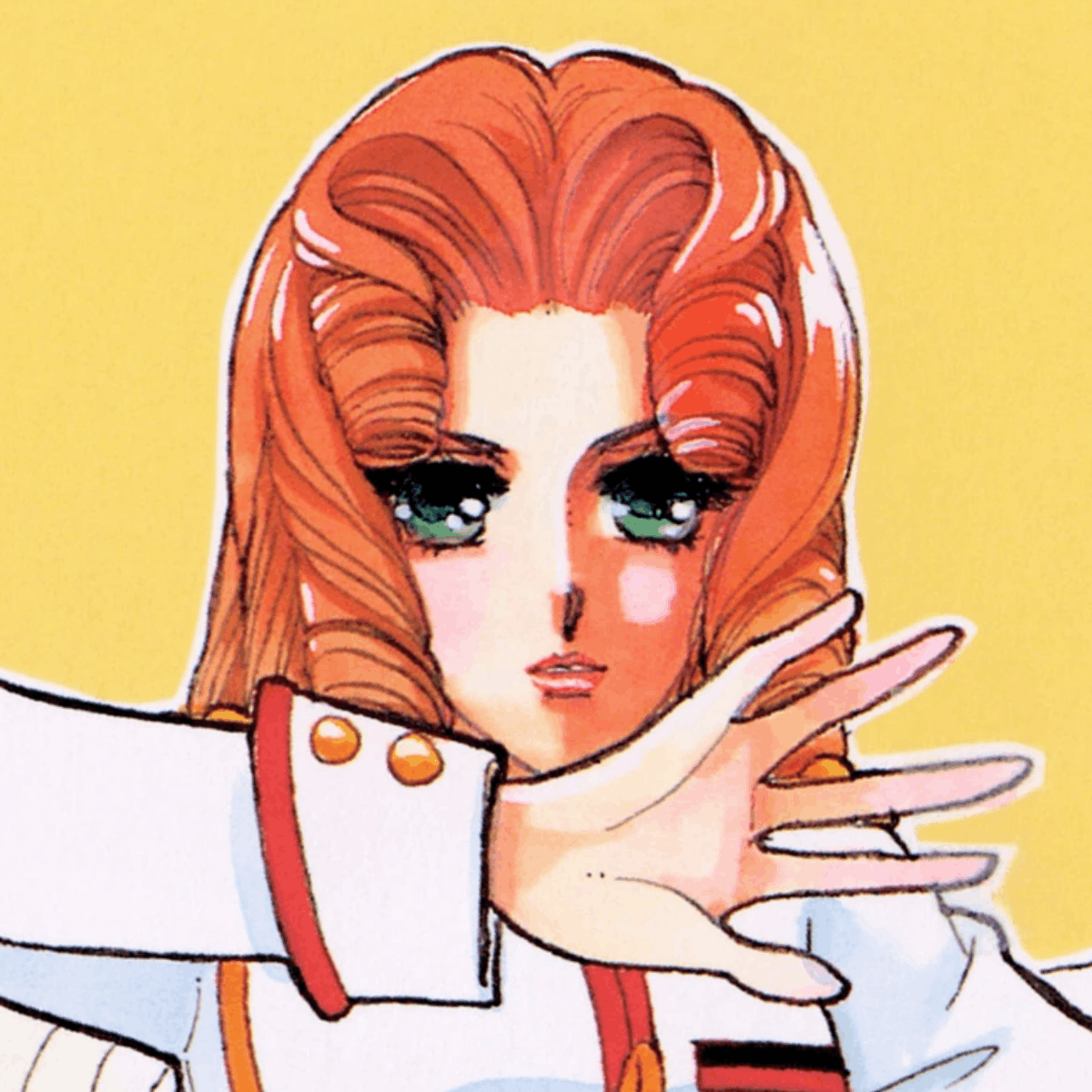
Juri Arisugawa
Treasurer and Fencing Team Captain
-
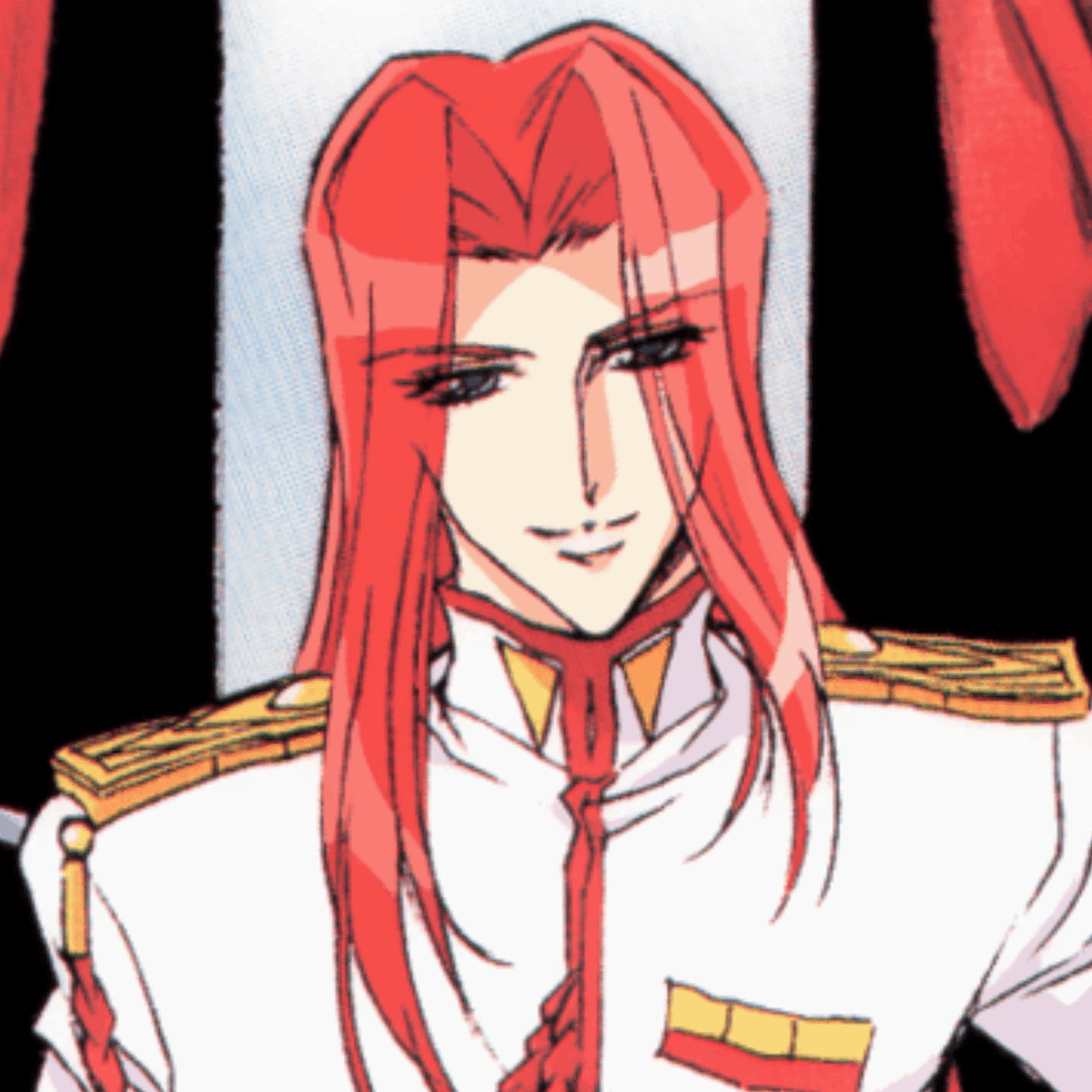
Touga Kiryuu
Student Council President
-

Nanami Kiryuu
Replacement President? Sorta?
Black Rose arc
After the Student Council members are defeated, the Black Rose arc begins. It follows the story of Souji Mikage, a university student who runs the "Mikage Seminar" which select Ohtori Academy students can attend. It's supposedly prestigious and academic, but it's really a way for Mikage to gain access to people close to the Student Council duelists so he can use them as corrupt Black Rose duelists, stealing the sword from inside a Student Council member.
-
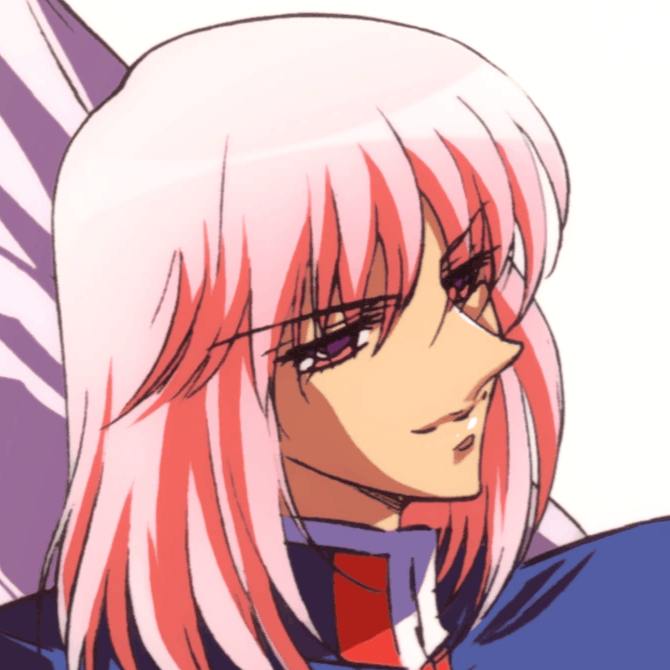
Souji Mikage
Genius
Black Rose Duelists
-
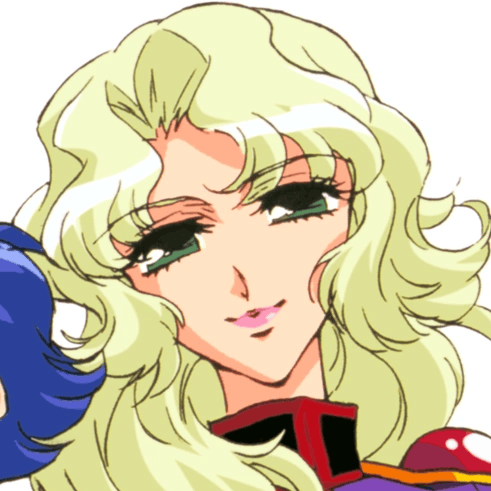
Kanae Ohtori
Daughter of the Ohtori Academy Chairman
-
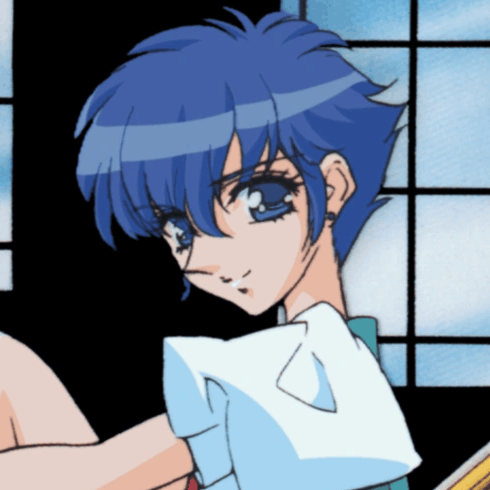
Kozue Kaoru
Miki's Little Twin Sister
-
Shiori Takatsuki
Juri's Ex-Best-Friend
-
Mitsuru Tsuwabuki
Nanami's..... Servant?
-
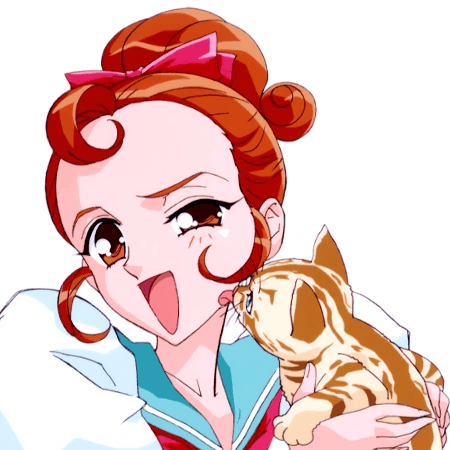
Wakaba Shinohara
Utena's Best Friend
-
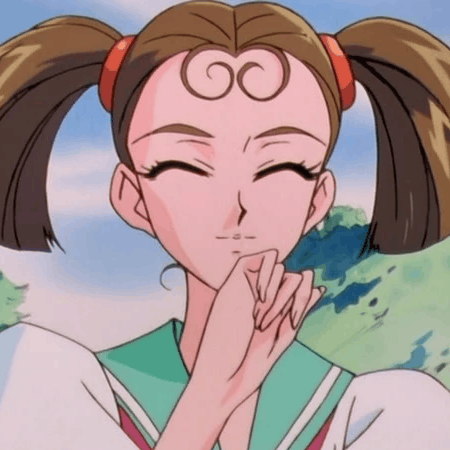
Keiko Sonoda
Nanami's Underling
But it was actually Akio, Anthy's older brother, scheming behind the scenes to control Mikage, using Anthy as Mamiya. They actually practiced this kind of trick already, if you count the Sega Saturn game as canon (see video game story) which...... you Could if you wanted.
Apocalypse arc
After Mikage fails, Akio's done using such fancy tricks, and it's in this arc that he reveals himself as the major villain that he is. Akio seduces the members of the student council using himself, their Black Rose loved ones, and one other guy as bait, inspiring them to duel again.
-
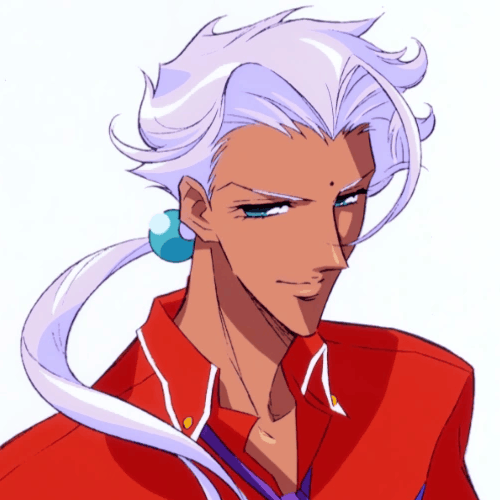
Akio Ohtori
Proxy Chairman of Ohtori Academy
Besides the duels, which are compunctory at best, the real story involves Utena's feelings toward Akio. Despite knowing that Akio is engaged to Kanae, she finds herself attracted to him to the point where she's considering abandoning her prince or her own princely goals. Akio takes advantage of this crush to manipulate Utena. After the final duel with Touga and Saionji, Utena learns that Akio and Anthy have been having sex.
Distraught and confused, Utena believes Anthy has betrayed her. Talking with Juri, Miki, and Nanami helps Utena wrestle with these feelings, although they don't know exactly what she's feeling, and Utena goes back to reconcile with Anthy. That night, Anthy tries to commit suicide by throwing herself off the tower, but Utena saves her. Anthy confesses to manipulating Utena and the others, and Utena apologizes for believing Anthy to have betrayed her.
The final duel is against Akio himself. He tries to convince Utena to become his princess and abandon Anthy, but Utena chooses to fight. Akio tries to convince her that she's incapable of becoming a real prince because she's a girl, and she can't save Anthy. No one can. At a pivotal moment, Anthy stabs Utena in the back with her sword, and Akio wins the duel.
But even though Akio has won, he can't break the door to save Anthy either. Utena gathers up the last of her strength, pushes Akio aside, and claws the door open with her fingers just wide enough to reveal Anthy on the other side. The Swords of Hatred stuck to Anthy have redirected to Utena. Utena calls to Anthy to reach out and take her hand, but they can't hold on and Anthy falls into darkness.
The next day, Utena has disappeared from the world. People have forgotten her or are starting to. Akio prepares the next rounds of duelists, but Anthy tells him she's done. She's free now to join Utena in the outside world, and leaves.
The End
Themes
Gender and sexuality
Thoughts about girls who are princes
Utena, our hero, uses the masculine first person pronoun "boku," wears a boy's uniform, and wants to be a prince. However, when anyone tries to call her a boy, she is quick to correct them. In some ways, she's even surprised when characters comment on her boyishness. Nanami twice calls her a "boygirl" (at least, that's how it was translated), and Utena is surprised. She doesn't want to be a boy. She wants to be a prince, which means being noble, courageous, and strong. There is a masculinity to being a prince, but it's not paired with a self-identification as a man.
Another aspect of Utena's "boyishness" is the way other girls faun over her. There's a moment early in the anime where Utena asks Anthy to stop calling her "Utena-sama," but then a bunch of lovestruck girls also call her "Utena-sama" as they wave her on her way to class, to which Utena, blushing, says it's okay for Them to call her that. The abstract schoolgirl crushes on a cute girl are fine, but in the intimate person-to-person interactions with Anthy, Utena becomes uncomfortable with it.
The opening of the anime has Wakaba waiting for someone who other characters call "her boyfriend," who is actually Utena. Wakaba frequently uses terms like boyfriend and date to describe her relationship with Utena, who begrudgingly accepts them, although she occasionally comments on the strangeness of them when they're "not true," although that has more to do with their relationship being more than friends than about the gendered aspect.
Touga and Akio are the primary forces insisting on Utena's girlishness, mostly to try and encourage submissiveness and romantic/sexual availability to them. Both characters are playboys who can basically have any sexual partner they desire, but they both chase after Utena and try to give her things to make her appear more feminine. Touga gives Utena a dress that she does initially wear, but she casts it off when the opportunity to do so occurs (and to save Anthy, no less! A princely act!) Utena routinely objects to Touga's advances, but when Touga defeats her in their first duel, Utena believes she's lost her princeliness, and she "becomes" a regular girl, which she shows by wearing the girl's uniform for the first time. When she regains her sense of nobility, that princeliness, after talking to Wakaba, and wins the rematch, she puts on her regular boy's uniform.
Akio, as an adult, has more effect on Utena's sense of girlishness. He also has the benefit of looking like her original prince from when she was younger. In the sequence where her meeting with the prince is described, Utena is described as not a little girl, but a princess. Akio makes her feel that way again, and he does things like buy her pretty dangling earrings that she ends up liking enough to wear, despite how overtly feminine they are.
In the final duel, Akio tells Utena that she can't be a prince because she's a girl. He insists that Utena is meant to be a princess, which he demonstrates by putting her in a princess gown. She can't save the damsel in distress because she's also a damsel. Turns out, not even the prince could save the damsel.
Juri is another character whose gender deviates from the norm. In many ways, Juri fulfills feminine expectations. She wears beautiful expensive clothes and jewelry, and she's even been a model before. Her hair is always in immaculate coils. Nanami in particular looks up to Juri as the kind of woman she'd like to be.
And yet, Juri is the captain of a rather masculine sport, fencing. Her student council uniform is the same as the other members of the student council—no skirt in sight. She's also known for being cold and assertive to the point of scary, not matronly or maternal in the slightest. And, of course, she's also in love with another girl.
Juri's not expressly described as a queer woman. It's just that the person she's in love with, Shiori, is a girl. When Shiori learns about Juri's feelings for her, she's more concerned about what that means for her own sense of inadequacy. She was under the impression that Juri, who she thought was so perfect, was secretly looking down on her, and now she knows Juri's true feelings for her, she can use them to be cruel to her, to punish her for being a better woman than her. Ruka, another character who knows Juri's feelings for Shiori, tries very hard to get her to abandon her crush, but it's under the pretext of wanting to spare her from Shiori's cruelty, not just because she was a girl and he was a guy.
But... they're both not Not punishing her for being queer. Abstract schoolgirl crushes are one thing, but a dedicated, intimate relationship between two girls is something that Juri keeps hidden. Shiori knows she can use Juri's secret as blackmail against her because it would reveal Juri as a queer woman, a potentially lesser woman. Shiori also doesn't seem to entertain the Ruka says he wants to spare her feelings, but he is also in love with her and wishes that she'd choose him, a more "appropriate" romantic target.
In the movie, Juri is called "the Prince" because she, like Utena, is gallant and strong. She plays the role of prince red herring given that Touga can't quite play that role in the movie, for other reasons. And it's believable because Juri manifests masculine qualities... and has feelings for a girl, a "princess." Shiori in the movie is... strange? She spends many scenes with Touga, who is dead, but her final scene involves her trying to stop Anthy and Utena escaping to the outside world. Shiori has the ability to leave the stale fantasy of their world because she's a car now, too (one with a frilly, girly interior, even), but she wastes her time and energy attacking Anthy and Utena, a queer couple, until she herself is destroyed.
In Juri's chapter in the After the Revolution manga, it's a complicated web of feelings for Shiori, but her primary goal is to be a prince there, too, to prove herself worthy of her princess.
Growing up
Yeowch, it hurts
Utena is about growing up. All of the main characters except for Akio are young people who lack agency in decisions regarding their own life. While the exact freedoms of the characters vary, they attend a boarding school where housing is assigned, cafeterias have limited food options, and passing classes is required. Most of the cast is fourteen or younger, so their bodies are still in earlier stages of puberty. Exploring their limits with romance and sex is a major component of the way that characters interact with each other. Adapting to changes in familial relationships as one ages is also a component. That's why there's so much incest.
The most explicit metaphor of adult freedom is driving a car. Even Touga, the oldest of the school-aged children, can't drive. In the last arc of the show, Akio regularly takes characters on long drives at night to show them "the End of the World," some glimpse of adult life that changes their outlook. His "dates" with Utena and even Wakaba are facilitated via car ride. In the movie, to escape to the outside world, Utena turns into a car.
Mitsuru is the youngest meaningful character, and he knows that he's too young to be a potential romantic partner for Nanami. He knows Nanami only has eyes for her big brother, so he wants to be that, too. We first meet him when he's throwing Nanami into various dangerous situations so that he can be the one to rescue her, just as he'd seen Touga do several years ago. His desire to grow up is the reason that Mikage is able to get him to the seminar and steal the sword from inside Nanami.
Over the course of the episode, he's goaded by another elementary school student, who chides him both for being childish and also for wishing to grow up faster. After his failed Black Rose duel, he still sticks to Nanami, but he can accept the differences in their relative maturities better.
Growing up also means escaping the simplistic narratives of fairy tales.
One way the cycle of violence is explored in the show is via the identity of the "prince." Utena wants to be a prince, she wants to be princely, and that involves certain attitudes and behaviors. A prince rescues damsels in distress. Utena understands Anthy as a damsel in distress, but Utena only knows how to respond to that in a princely fashion: participating in the dueling game. When she loses Anthy in her duel against Touga, she is deeply depressed, but she's inspired to duel Touga again explicitly not for Anthy's sake, but for the sake of restoring her self-perception as a prince. Utena tells Anthy this directly, and Anthy smiles blankly.
A prince can't save Anthy, and Anthy knows this, which is why she stabs Utena in her final duel against Akio. If Utena were to win the duel, it would not save anyone, it would not open the door to the floating castle, it would not grant one eternity or a miracle or the ability to return to one's happy memories. Being a prince is ultimately meaningless in the face of actual suffering of a complex human person, not the simple damsel-in-distress who Anthy has been in Utena's life up until that point.
After Utena is stabbed, Akio is the winner of the duel, but even as the current "prince" he's unable to open the door to free Anthy. Utena has failed to be a prince. After she was stabbed, she is no longer operating by the rules of the dueling game, and that's when she's able to open the door and see the true Anthy. The Swords of Hatred turn on Utena, marking her as the next victim of the cycle of violence, but instead Utena disappears from the world. She's no longer part of this pretend world of princes that the rest are trapped in. Anthy is also freed by the recognition of true self as a complex person, and her own acceptance of this within herself, and the final scene is her leaving to join Utena outside.
Incest
Discussion of incest between siblings, including rape
Incest is a major theme of Revolutionary Girl Utena. There are three pairs of siblings who represent different ways that incest manifests, each related to other themes throughout the work.
Kozue and Miki
Kozue and Miki are twins. They used to play piano together, but Kozue says she never enjoyed it, wasn't good at it, and only did it to please Miki. When they were young, they were scheduled to perform a concert together. Miki became too sick to perform, so Kozue was supposed to play alone. She ran away from the waiting audience and stopped playing piano all together, and the relationship between the two was never the same afterward.
Kozue is possessive and passive-aggressive toward Miki. She tries to make him jealous by dating or making out with other boys while she knows he's watching. When Kozue learns that Miki's attention is now on Anthy Himemiya, she is furious. In the Black Rose arc, she is the one who pulls Miki's sword from his chest and duels Utena with the black rose crest. In the End of the World arc, she goes with Akio and convinces Miki to go with her, saying that the only way to move forward is to get "dirty." She calls herself a wild animal. During the End of the World arc duel with Miki, Kozue is in the car with Anthy and sexually assaults her because she knows Miki is watching, although she berates him for getting distracted.
In the movie, they bathe naked together, but she hold a razor to his throat when she suspects the slightest hint of betrayal.
In the manga and in the light novels, Kozue is kidnapped and Miki duels to save her. Touga says in the light novels that Miki's choice to save his sister over pursuing a relationship with Anthy is a sign of his immaturity. When Kozue and Miki sleep in the same bed together after she's rescued, it's because Miki is a child.
Kozue resents having to grow up and change, to join in the messy adult world, and yearns to return to a simpler, more innocent time. Her incestuous feelings for Miki are manifestations of these feelings, and Miki's placations yield to those desires.
Because they are twins, they also are used to using the other as a personal yard stick for development. If someone is "ahead," then the other is "behind." Keeping the other close and in the same state as you means never having to be "behind." As kids, they looked more alike, but puberty has forced more differentiation between them, and in ways that highlight the sexual possibilities between the two. Sharing a bath is no longer a completely sexless bonding experience.
In After the Revolution, a series of manga chapters showcasing the adult lives of the members of the student council, the chapter featuring Miki is also about Kozue and what it means to have an adult relationship with her. Even as adults, they're still in this mess. Kozue is in love with Miki in an explicitly romantic way. Unable to stop herself, Kozue goes to Miki's room while he's sleeping and kisses him. Miki wakes up and, shocked, pushes her away. Feeling that she's destroyed their relationship, Kozue ends up marrying a different man, but she comes to Miki one day covered in bruises explaining that she still loves him and her husband beats her because he can tell she's in love with another man. She kisses him again, and Miki again pushes her away. Kozue runs away but ends up in a coma. Her husband abandons her, and Miki visits her. At a party, Touga hears someone playing Miki's finished song, but Miki tells Touga he hasn't finished it. It turns out that Kozue sleepwalked and then sleepplayedthepiano, finishing Miki's composition, and Miki follows Kozue when she does it again and plays the piano with her. There's a little bit of magic involving the spirit of child!Utena that happens, but Kozue wakes up and Miki tells her that he wants to have A relationship with her, and the exact nature of that relationship will have to be sorted out, but he loves her and doesn't want to leave her alone. He emphasizes that their relationship has to grow and change into a mature and appropriate one, but they can still have a relationship built on love.
Touga and Nanami
Touga is Nanami's big brother. Everyone knows Nanami is obsessed with her big brother. She chases other girls away from him, even her own friends/underlings, with cruel zeal. She clings to him, physically and emotionally, and seeks his protection whenever she's in trouble. His opinion of her means everything.
Touga is seventeen. Nanami, like Kozue and Miki, is only thirteen, and her mixed feelings about growing up are also reflected in her interactions with Touga. As children, they were allowed to be close to each other, including physically, but the gap between them has only grown wider as Touga is years into his own puberty by the time Nanami is just beginning hers.
Her self definition is also predicated on the fact that she is Touga's little sister. She's special because Touga is special, the president of the student council and good at sports and excellent grades, and she is his little sister. She's above the girls who have to grovel and sneak their way into his affections because their relationship is bound by blood.
In the episode "Nanami's Egg," Nanami wakes up one morning and discovers an egg in her bed, and she believes that she laid it. The shame and fear of this potential gaping hole in her understanding of her own body pervades the episode as she imagines everyone around her laughing at her for being "late" to the egg-laying game. She's afraid to ask anyone directly if it's possible that she laid it, because if she could she should definitely know. There's even a moment where Nanami marvels at Juri's maturity because she thinks that her bowling ball in its bag is actually Juri's own very large egg. When she does accept that this is a sign of her growing up, in the possibility of maternal feelings, she starts to treat the egg extremely well, hoping for it to grow and hatch.
However, when Nanami dances around this topic when talking to Touga, Touga tells her that he would never want to live with a woman who laid an egg. Horrified at being the kind of woman that Touga would despise, Nanami runs into the woods and abandons her egg. This is obviously very silly, but there's no reason for Touga to have said such a thing about such a silly premise unless he was deliberately trying to mess with Nanami. Which he'd been doing.
Touga routinely uses Nanami's obsession with him to fuel his own ego and to manipulate her into doing things for him. After Touga rescues Utena from Saionji, Nanami perceives Utena as a rival for Touga's affection, and Touga uses the opportunity to give Nanami a rose crest seal to allow her to participate in the duels so he can observe and take notes to make his own duel more effective. Nanami's desire to hurt Utena surpasses her desire to follow the funny rules that Touga and his friends play pretend with, so she continues to attack Utena after the duel is over, until Touga relents.
After Touga spends more time with Akio, he starts to play with Nanami's feelings for him even more. One day, he invites her to shower with him, waits for several seconds while she's speechless, and then says "never mind, of course not." It's one of the first times where the apparent sexuality of her feelings for him is made so clear. She knows that despite wanting to go back to a time where they could bathe together, taking a shower together now is something else. Touga is cruel for suggesting it.
Akio and Touga manipulate Nanami's incestuous feelings directly after Touga "lets slip" that Nanami isn't actually blood related to him (he is lying) and that he would otherwise never be seen interacting with her (... maybe the truth?). She understands herself as Touga's little sister. She's special because she's Touga's little sister, and he's the best. If she's not Touga's little sister, who is she? If she's not the little sister that Touga loves, she's just like every other girl swooning after Touga. She has no special relationship with him, and so her feelings for him are pedestrian. She's just like everyone else.
She falls into a deep funk and refuses to go home where she might encounter Touga and have to deal with the feelings directly. Akio, so kindly, invites her to stay with Anthy, Utena, and himself. Akio and Anthy manipulate the sleeping arrangements such that Nanami witnesses Akio and Anthy having sex. Confronted with the reality of what indulging romantic and sexual feelings for her brother might look like, she is deeply disturbed and runs away.
When Akio and Touga get her in the car on the way to see the End of the World, Touga tries to kiss her, and she rejects him. She's seen the result, and she doesn't want it.
Nanami is the only one who expressly abandons the dueling game and End of the World after her final duel. She tries to leave the school, the coffin of immaturity. She is changed and grows up when she understands that the childish attachment to Touga was unhealthy, even though she is now forced to redefine herself for her own sake.
Akio and Anthy
Akio, Anthy's adult brother, rapes Anthy routinely over the course of the show. Utena notices that Anthy isn't around much on weekend nights, and we the audience learn it's because Akio compels her to come to him so that he can rape her.
Anthy is a very quiet and distant person who is disconnected from others. In some ways it's literal, as in the birdcage-shaped flower garden that she tends to mostly alone. Mostly, she's noted by everyone else for not engaging with her peers.
Anthy often explains her strange behavior by stating that she is the Rose Bride. This title morphs meanings over the course of the show, but by the end we learn that the Rose Bride is the title given to her as punishment for trying to protect her brother, Prince Dios, from harm by people who were using him. For denying people access to Dios' body, she is forever ensnared, pierced by the Swords of Hatred, and writhing in pain forever. The dueling game is assumed to be looking for the prince who can save the Rose Bride because her prince, her brother, the one who could save her, the one who she saved, has fallen. He is now Akio, the Devil, the man who uses her body for sex and her magic for manipulating others.
Anthy's psychological distance from others is created because only Akio, who uses her for his own sexual and psychological gain, is the only one who truly understands the extent of her suffering, and even then only from the outside. She is alone in her pain, and her dissociation is one of the few ways she can escape it. In one scene, after Akio has raped her, Akio accuses her of being cruel to him because she doesn't respond and denies him any kind of reaction that would make his actions mean something. She just smiles blankly and leaves.
While the Kozue/Miki and Touga/Nanami relationships are mostly related to the themes of growing up, the physically violent incestuous relationship of Akio and Anthy speaks on the theme of the cycles of violence. Dios' body was violently used as a prince, where he was forced to participate in dangerous escapades to save others. When Anthy steps in, denies others access to his body, they inflict violence onto hers. Dios, Akio, reenacts that same cycle and also enacts violence onto Anthy's body, as well as facilitates it by others via the dueling game.
But their relationship is still affected by the differences between children and adults. Anthy and Akio have been doing this whole Rose Bride and dueling game thing for a long time, so their exact "ages" are slightly ambiguous, but Anthy is still stuck in the world not only as the Rose Bride but also as a middle school student. She's fourteen. She's maybe been fourteen for a while, but she's still only fourteen, and she lacks the freedoms of an adult. She can't choose where she lives, she can't choose what classes she has to take, and she can't drive. Akio is the acting chairman of the entire school. He has considerable freedoms as an adult that Anthy doesn't, and he uses them in cruel ways. For example, in the second half of the show, Akio reassigns Anthy and Utena's housing, increasing his access to both of them, and uses his freedom of movement via car to separate the two of them. In this case, the problem is that Anthy is stuck in her situation because she Can't grow up, and Akio is still stuck in his situation because he Won't grow up out of the framework of the prince.
Production
Be-Papas
Be-Papas was a production company led by director Kunihiko Ikuhara, whose most famous work up until that point had been Sailor Moon with Toei Animation. He had directed many episodes and became the series director for season 2 and onward. By season four, however, Ikuhara disliked how little creative control he had over the show and left to form Be-Papas along with the manga artist Chiho Saito, producer Yuchiro Oguro, animator Shinya Hasegawa, and writer Yoji Enokido. With this new freedom, they created the original series Revolutionary Girl Utena.
The exact story of Revolutionary Girl Utena varies between the manga, anime, and movie, all created by Be-Papas, so what counts as "canon" is up for interpretation. For most, the primary material is the anime that ran for 39 episodes in 1997, but the manga was published in 1996 (and Saito was given a lot of freedom with the story and characters) and the movie came out in 1999 (which Ikuhara had much more control over), and they both have significant differences in the plot. There's also the 1998 light novels, but they were not written by someone in Be-Papas, so they're not generally considered canon.
North Pole lemming Siberian antelope
J.A. Seazer created the operatic rock main duel music. Seazer got his fame composing music for Shuji Terayama, an avant-garde theater director who wrote plays about the 1960s student protest movement in Japan, among other things. Terayama's influence can be seen throughout Utena (check out this article by Clover Demerritt for Anime Feminist for more about underground Japanese theater's influence on Utena). Ikuhara thought Seazer's music would be perfect for a story about attempted revolution.
The music is awesome. The main duel theme that starts as Utena ascends to the arena and continues through the fights is the track Absolute Destiny Apocalypse, and it's so cool we added it to the player below. The lyrics are dark and foreboding, and the song ends with a repeated, meaningless chant as if praying or meditating or invoking a dangerous spirit.
Duels have their own rock opera tracks. Different duelists have certain aspects of their motivations or the consequences of the outcome emphasized by the incredible lyrics. The following is a list of the songs ordered by episode, each with a link to their lyrics and translations by Empty Movement and a timestamped link to the episode in which they appear.
Song to episode mapping (click to reveal spoilers)
- Episodes 1 and 2 duels with Saionji: Nikutai no Naka no Koseidai - Paleozoic Within the Flesh
- Episode 5 duel with Miki: Spira Mirabilis Gekijou - Miraculous Spiral Theatre
- Episode 7 duel with Juri: Tenshi Souzou Sunawachi Hikari - Angelic Creation, Namely, Light
- Episode 10 duel with Nanami: Last Evolution (Shinka Kakumei Zenya) - Last Evolution • Eve of the Evolution Revolution
- Episode 11 duel with Touga: Fuuin Jubaku - Seal Spell/Sealed Curse
- Episode 12 rematch against Touga: Nanibito mo Kataru Koto Nashi - No One Has Anything to Tell
- Episode 14 duel with Kanae: Fujingenkon Gattaijutsu - Inhuman Illusory Soul Fusion Magic
- Episode 15 duel with Kozue: Kakuu Kakokei Majinai - Utopian Past Tense Incantation
- Episode 17 duel with Shiori: Chikyuu wa Jinbutsu Chinretsushitsu - Earth as a Character Gallery
- Episode 18 duel with Tsuwabuki: Ensuikei Zettairan Algebra - Conic Absolute Egg Algebra
- Episode 20 duel with Wakaba: Gentouchouga Juuroku Seiki - Magic Lantern Butterfly Moth 16th Century
- Episode 21 duel with Keiko: Seijuku Nenrei Toumeiki - Transparent Period of Adolescence
- Episode 23 duel with Mikage: Watashi Kuusou Seimeitai - I Am An Imaginary Living Body
- Episode 25 duel with Saionji: Virtual Star Hasseigaku - Virtual Star Embryology
- Episode 26 duel with Kozue and Miki: Heizoku Uchuu ni Fumetsu no Koutei - An Immortal Emperor in a Mundane Universe
- Episode 28 duel with Shiori and Ruka: Tenshi Androgynous - Angel Androgynous
- Episode 29 duel with Ruka and Juri: Watashi wa Banbutsu Hyakufushigi - I Am All the Mysteries in Creation
- Episode 32 duel with Nanami and Touga: Tennen Douhou Kyuuden Enkinhou no Sho - The Natural Compatriots' Palace Perspective Book
- Episode 36 duel with Saionji and Touga: Guui Guuwa Guu-est - Allegory, Allegorier, Allegoriest
- Episode 38 duel with Akio: Tainai Tokei Toshi ORUROI - Internal Clock, Municipal Orrery
- Episode 39 when the Swords of Hatred begin again: Missing Link
A strange quirk we experienced while watching the show was an issue with subtitles. We found some servers that would display the song lyrics at the top while dialog was subtitled at the bottom, but there were several episodes where there was a single subtitle track that covered both music and dialog. Sort of. During duels, the subtitles were the translations for the lyrics of the song, and the dialog was secondary. We had to consult transcripts for several episodes because the content of the conversations didn't end up in the subtitles. A bold, inconvenient choice.
Some of the songs have lyrics that are more free association. One such song, Allegory Allegorier Allegoriest, includes lyrics about the end of the world, about impending extinction, about creation, and about how people's lives can become symbols in their messy fight for existence. It's beautiful. What it meant in practice while watching the show, however, was that a main character's dialog in a pivotal scene was obscured by subtitles like "North Pole lemming Siberian antelope."
To avoid this situation, just watch the series on Youtube. It's free. We found it too late.
The Story of a Revolution Yet to Come
Who the fuck is Chigusa Sanjouin?
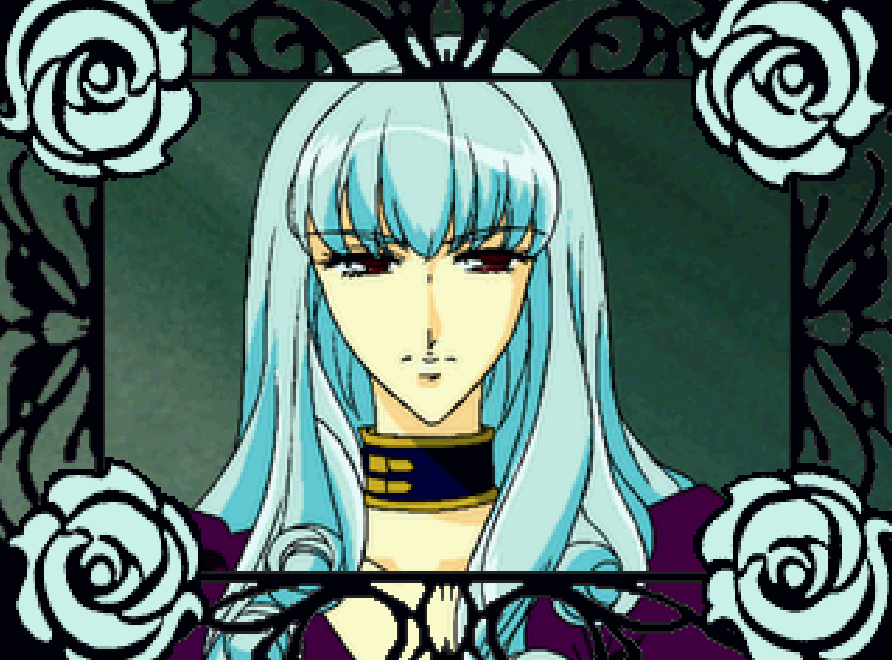
After watching the anime and reading the manga and light novels, we encountered the name of a character who we'd never seen: Chigusa Sanjouin. Turns out, Chigusa is the antagonist of the Sega Saturn Utena video game Shoujo Kakumei Utena: Itsuka Kakumei Sareru Monogatari (Revolutionary Girl Utena: The Story of a Revolution Yet To Come).
Tone
When you load up the game, an opening cinematic plays. It starts with a pink rose opening up as music swells, then more roses in front of a red theater curtain. The red curtain pulls back to reveal a second theater curtain, in Rose Bride colors. A rose crest swirls in the center, only to be tossed aside to reveal Touga, Akio, and Saionji as they start to sing.
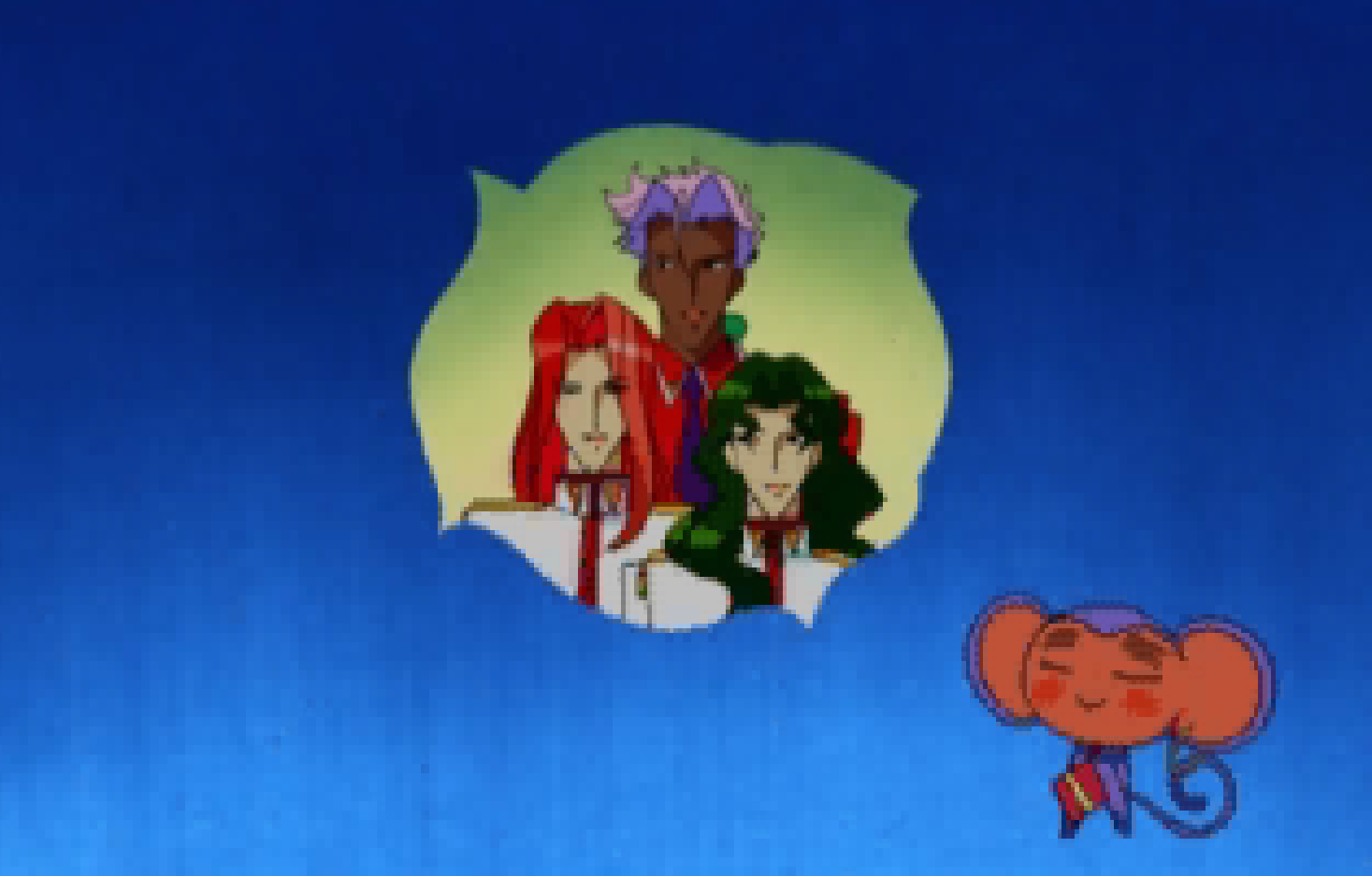
Then Touga and Akio THROW open their shirts, showing off their chests. Akio's pants are undone and pulled down slightly, and as he slides down the camera you see his tongue sticking out. Just as Saionji's about to do the same, Touga and Akio's faces cover the screen to keep him hidden.
Akio's Exposed Chest
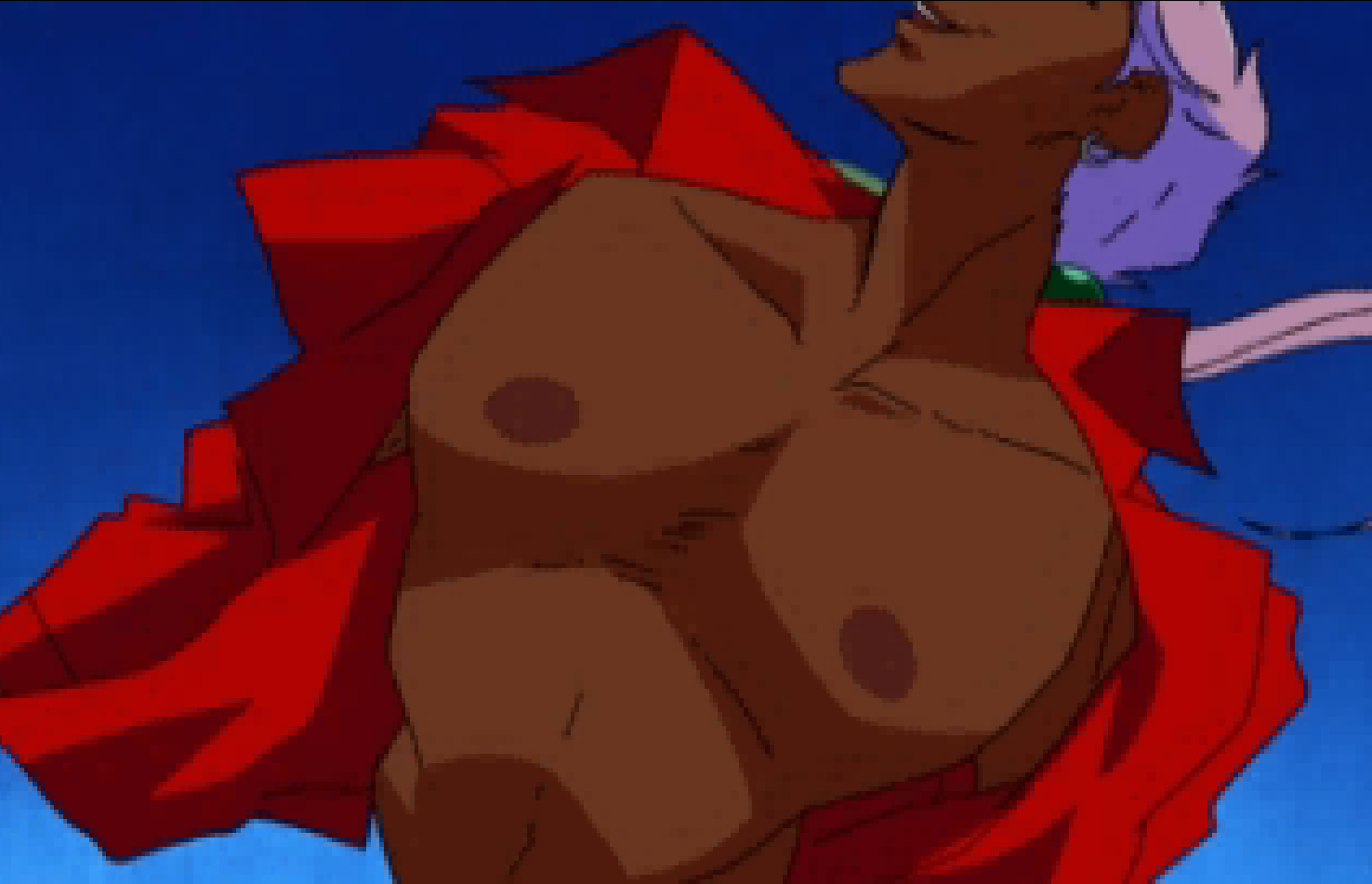
So that was a bit of a shock.
Tonally, the game is completely different than the show. This is not a game about exploring cycles of violence. This is a romantic visual novel.
Don't worry, though, there's still incest.
Knowing that, here we go.
Game Story
The game takes place between episodes 8 and 9 of the anime. Your character is a new transfer student to Ohtori Academy.
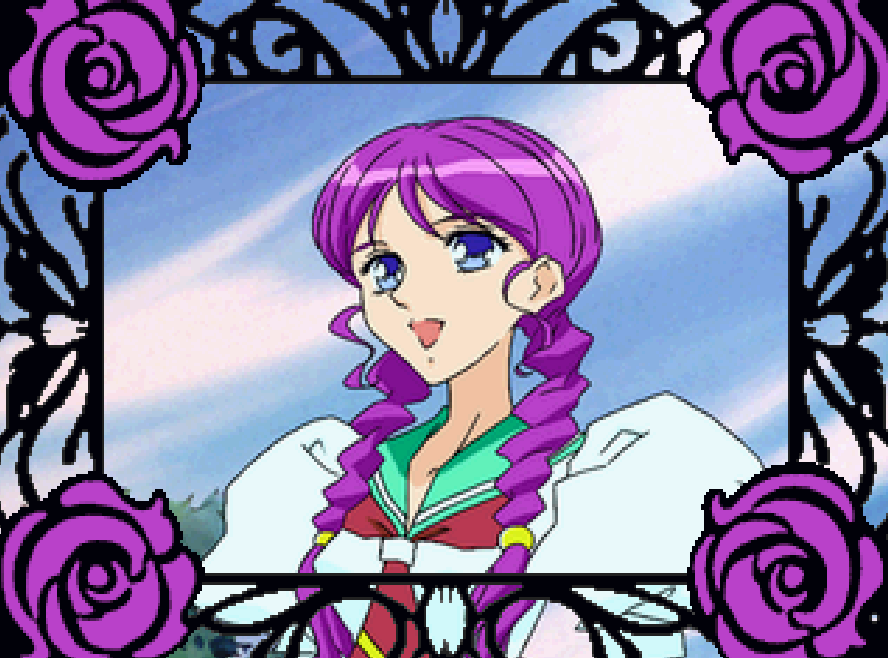
Your parents met there when your father (who has suspiciously Touga-like hair) was the advisor of the fencing club, and they hope you have a good time at their alma mater.
As soon as you arrive, you see Saionji slapping Anthy. You can choose to say something, but either way Utena comes and sets things straight. You learn about Utena's princely backstory and about the purpose of the duels before your classes end, after which you get to meet Akio and learn where you're going to be housed (East dorm, like Utena and Anthy!). Akio is sure to mention the chalk-white old fencing hall.
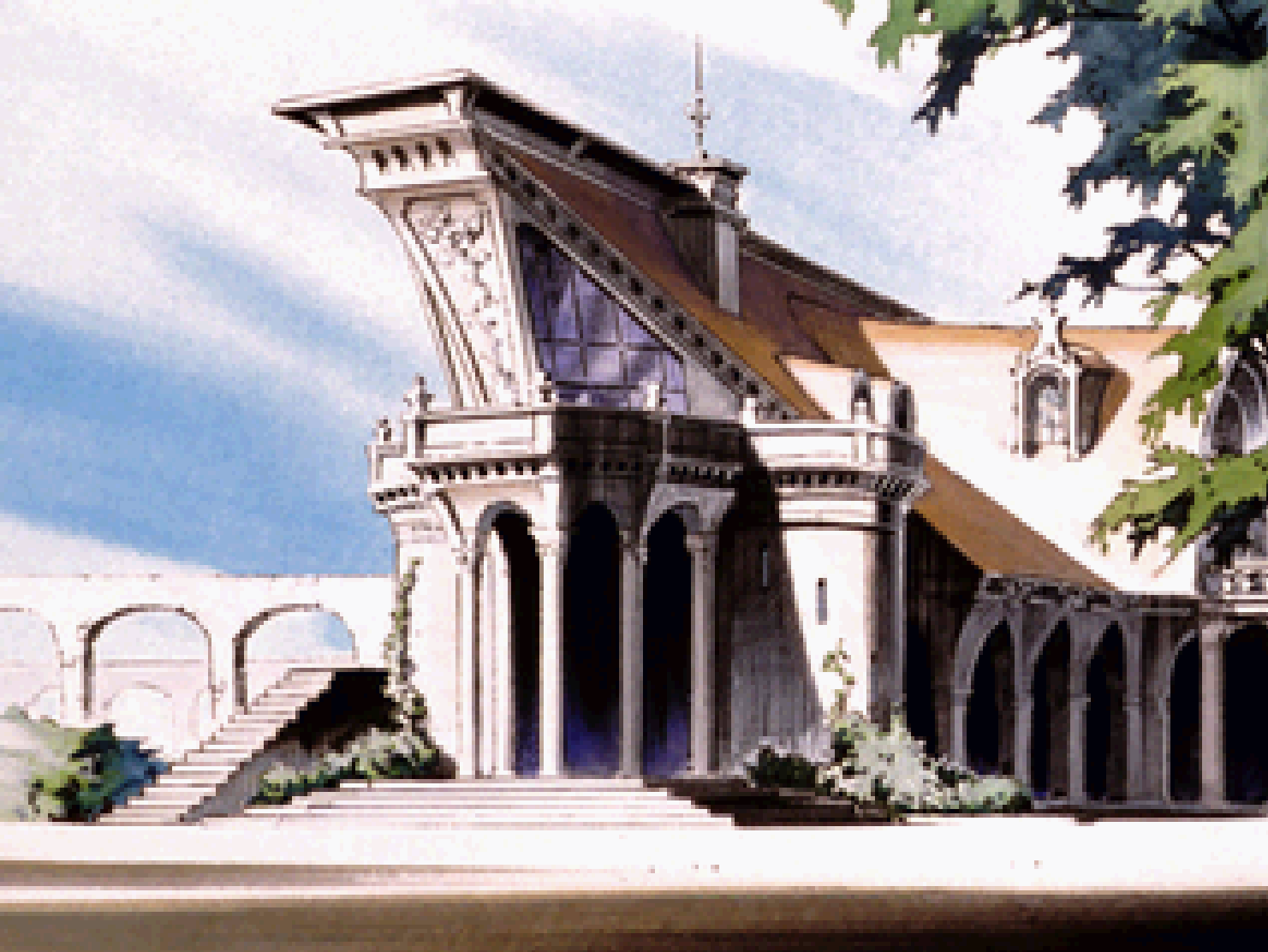
You go to the old fencing hall and see strange things on the walls, like an old calendar from fifteen years ago, name tags with the fencing club members (including a President Chigusa, but the club advisor's tag is missing), a strange diagram... You also meet a beautiful person of indeterminate sex with blue hair and a purple gown in the fencing club locker room. When you give her your name, she seems surprised, and asks if your parents are named Masaomi and Koto. (They are!) Strange... but she chases you off.
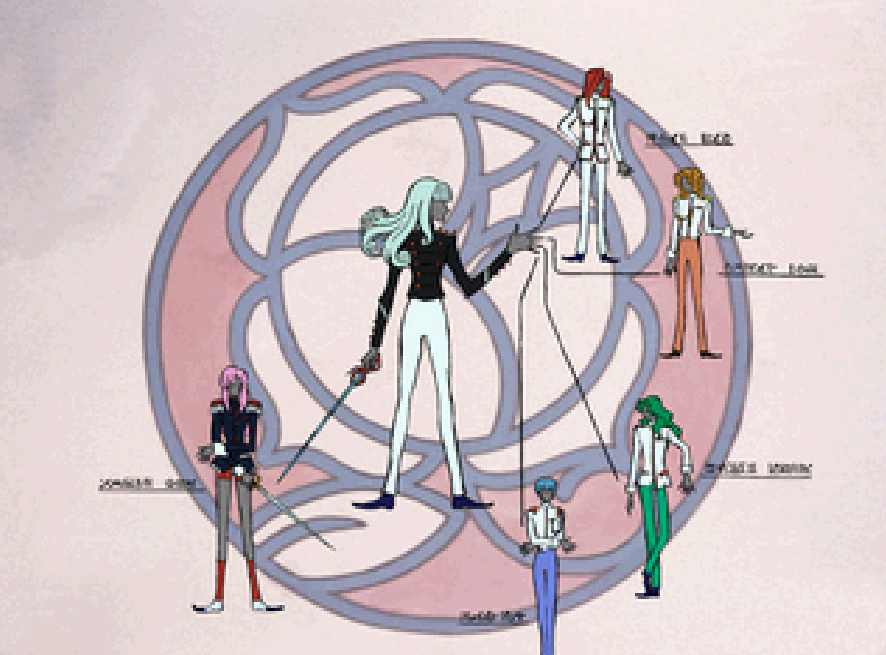
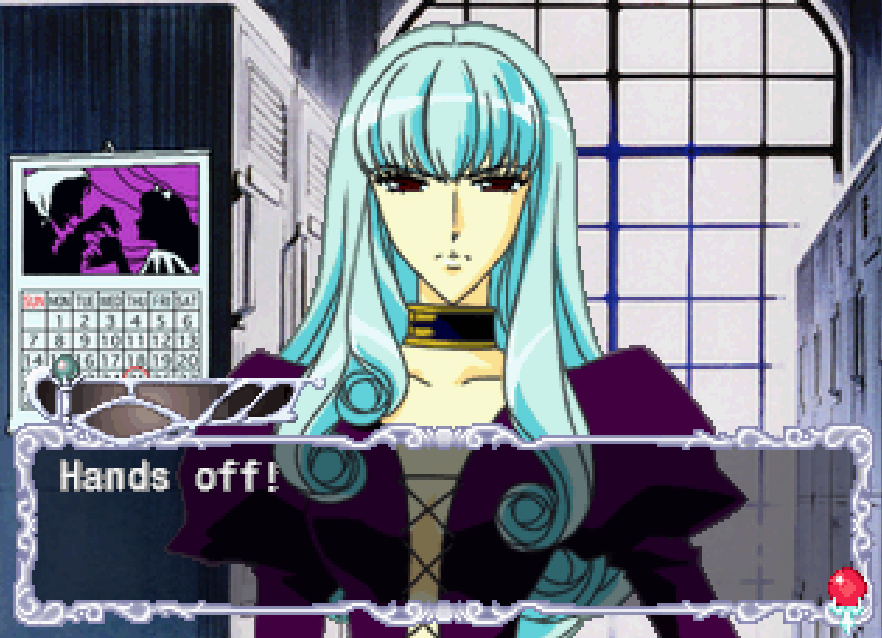
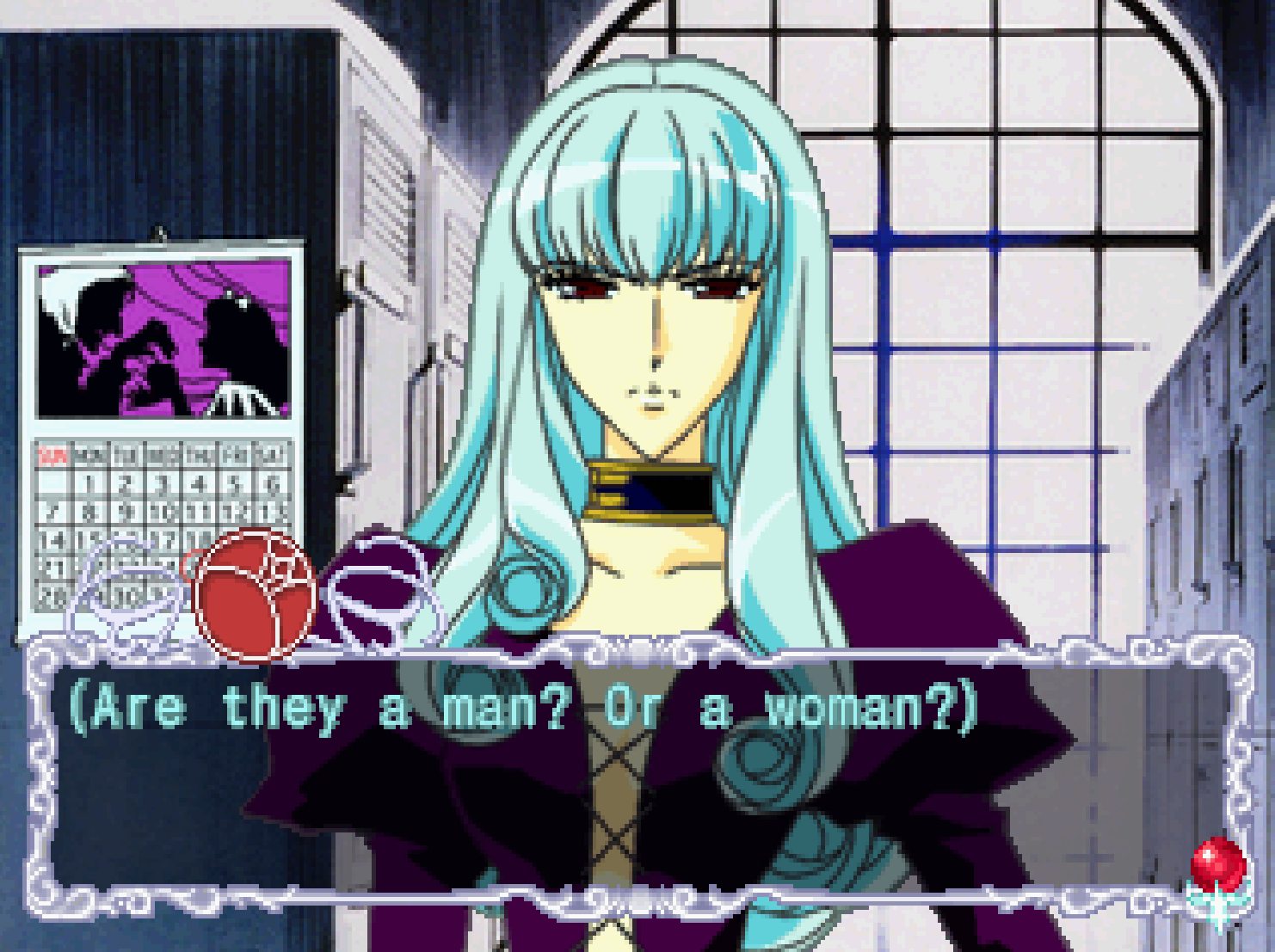
The student council agrees to extend you an invitation to the masquerade ball, given that your rooming assignment must have been permitted by the End of the World. There, you can interact with the student council members for the first time. Also: a mysterious person with long blue hair is also there! You dance, and they show you their rose crest ring. They promise to duel Utena and that, when they win..... you will disappear! And then they leave... and then someone trips the power! Perhaps... sabotage? When the lights come back on, taped to your back is an invitation for Utena to duel on the 25th.
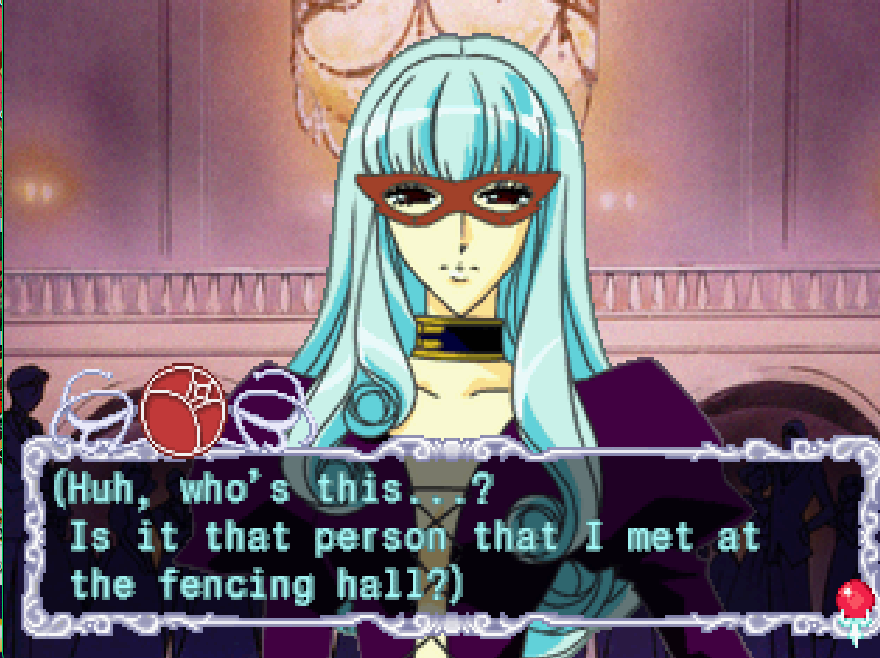
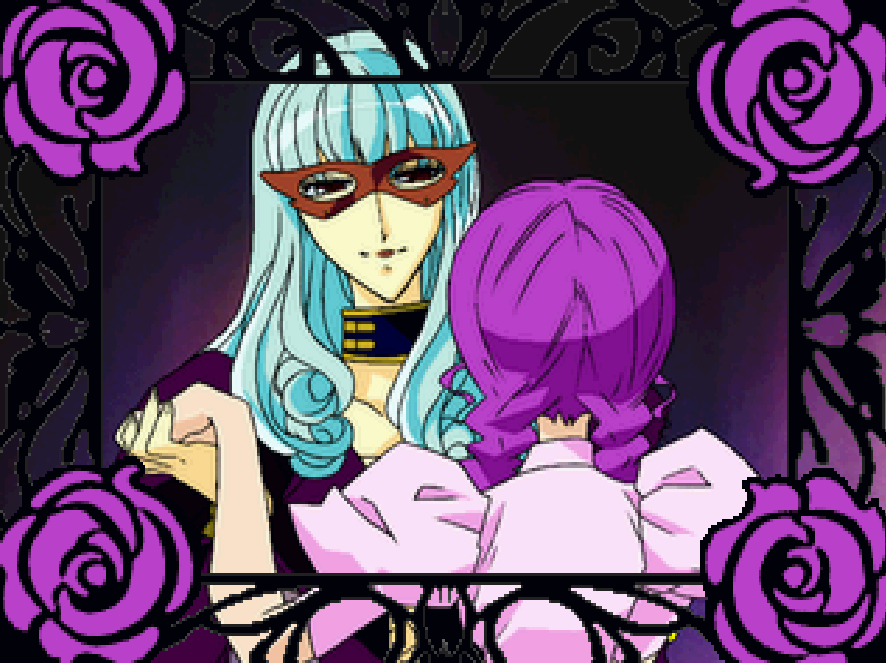
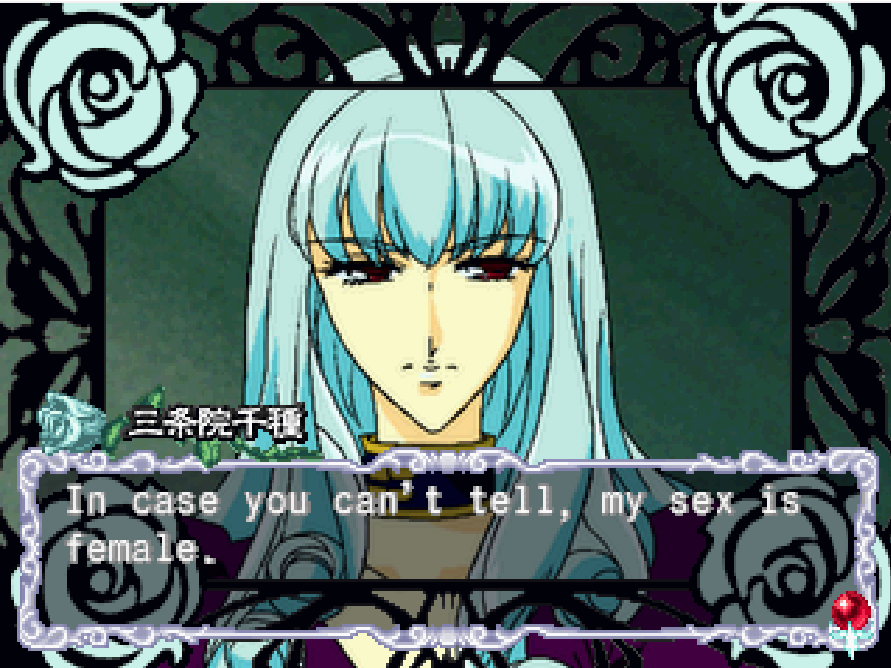
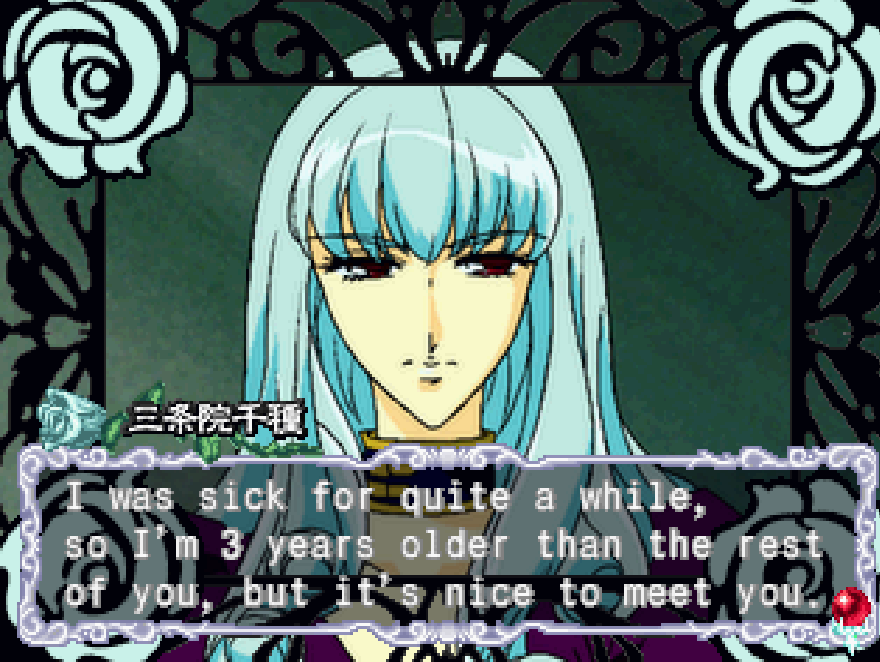
The next day, the 23rd, a blue-haired person joins your class. She's a girl. She was sick for some time, so she's three years older than you, Utena, and Anthy, but she's there. She greets you by the name you gave in the old fencing hall, but then she says that it's the first time you've met. Hmmmm!
You also learn that the old fencing hall has been abandoned for years. But you went there... how could it be ruins?
You spend the next few days interacting with Utena, Anthy, and the student council members and investigating Chigusa. You can attend club practice and talk to people, and after school you can go to various shops and meet them there. Twice, you get to pick who to have dinner with and meet late at night.
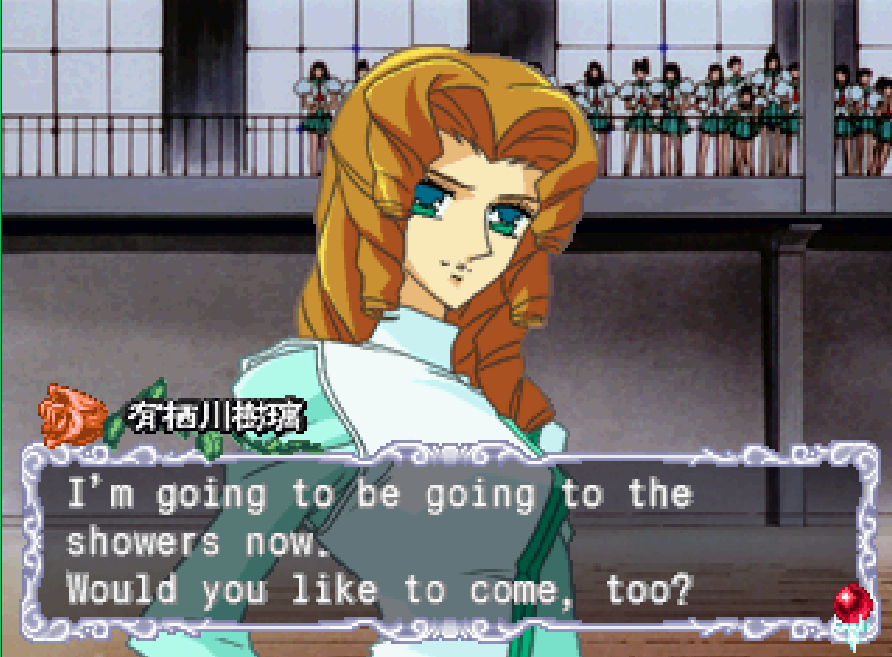
Actual shower scene images
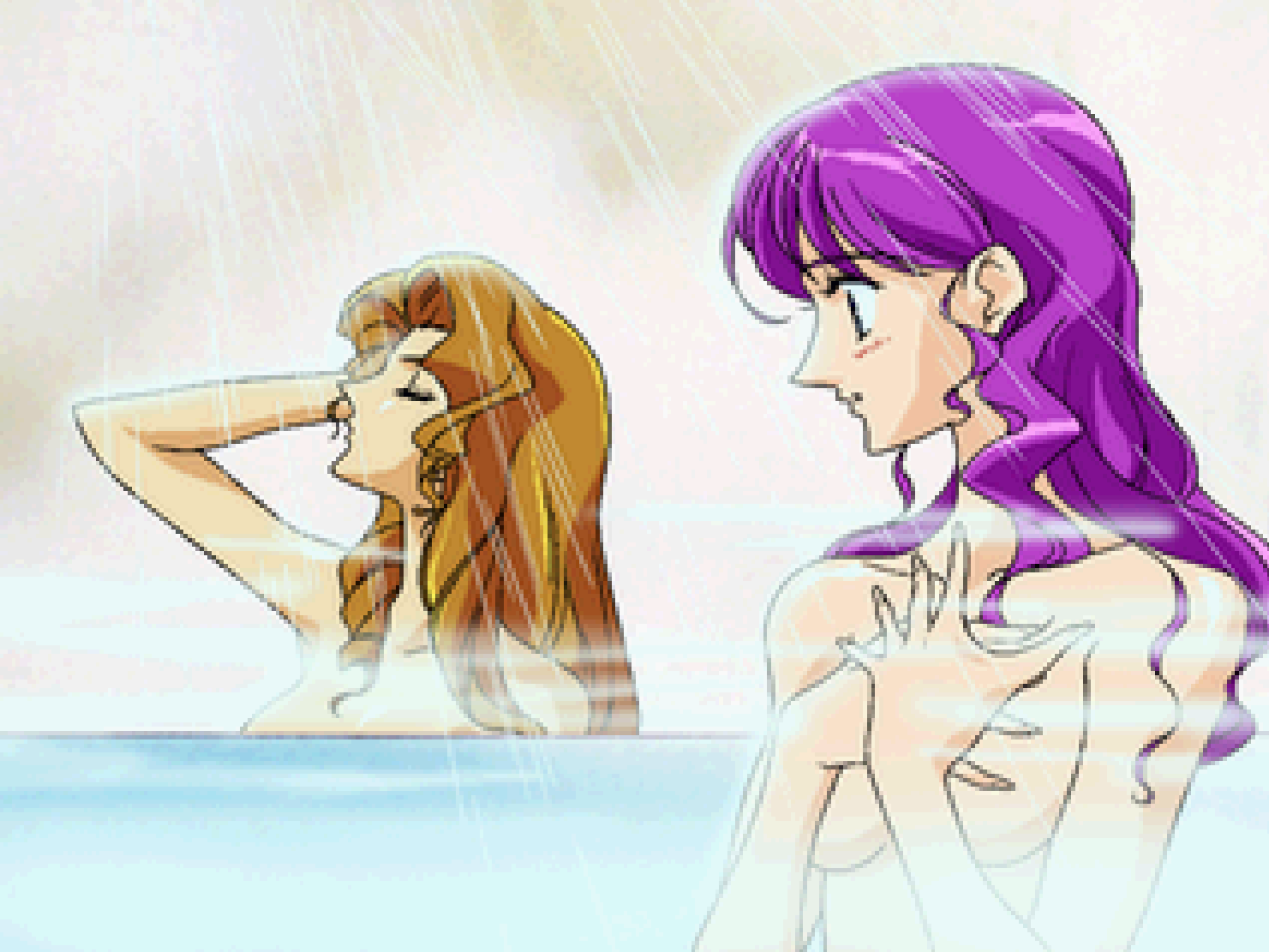
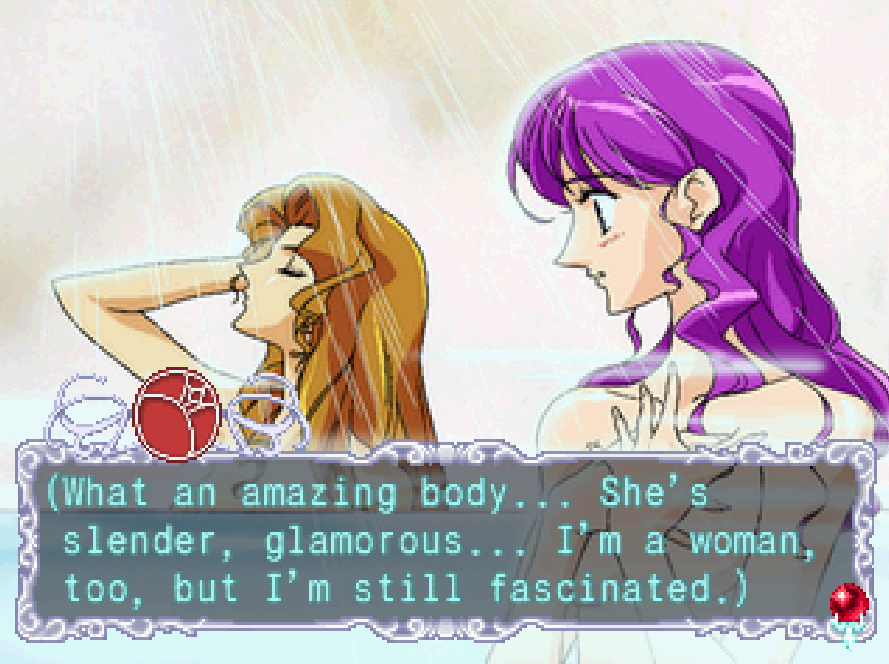
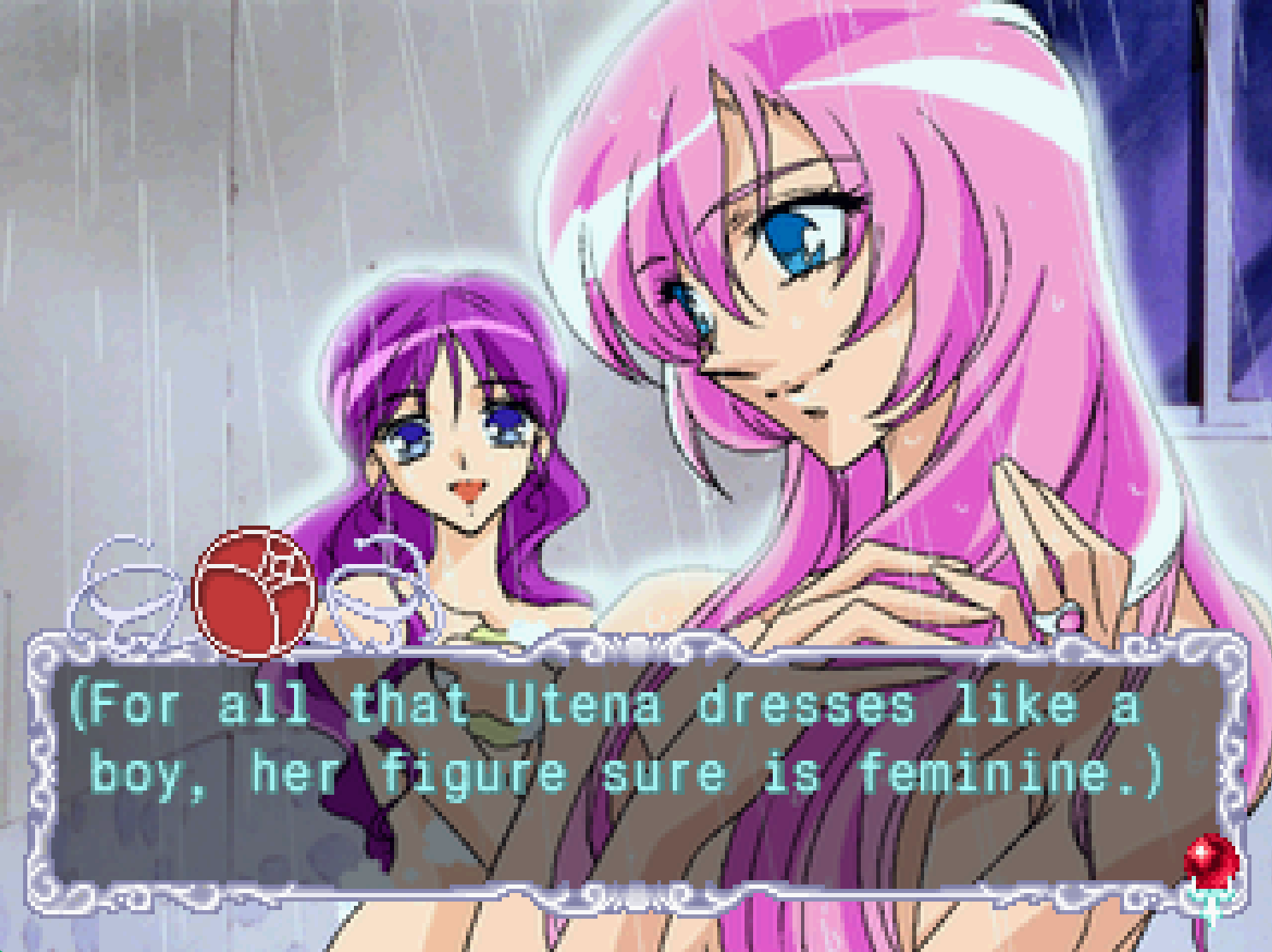
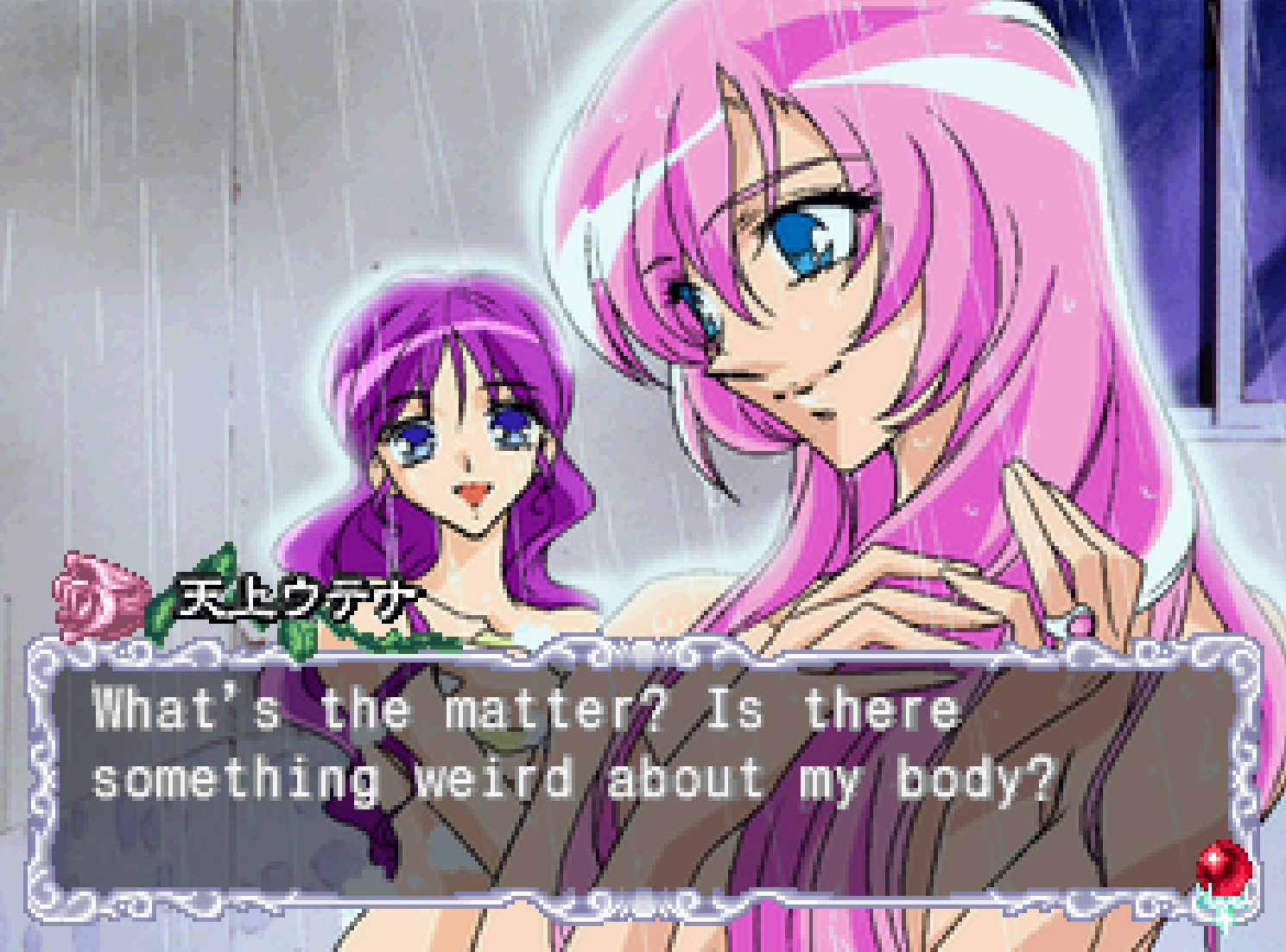
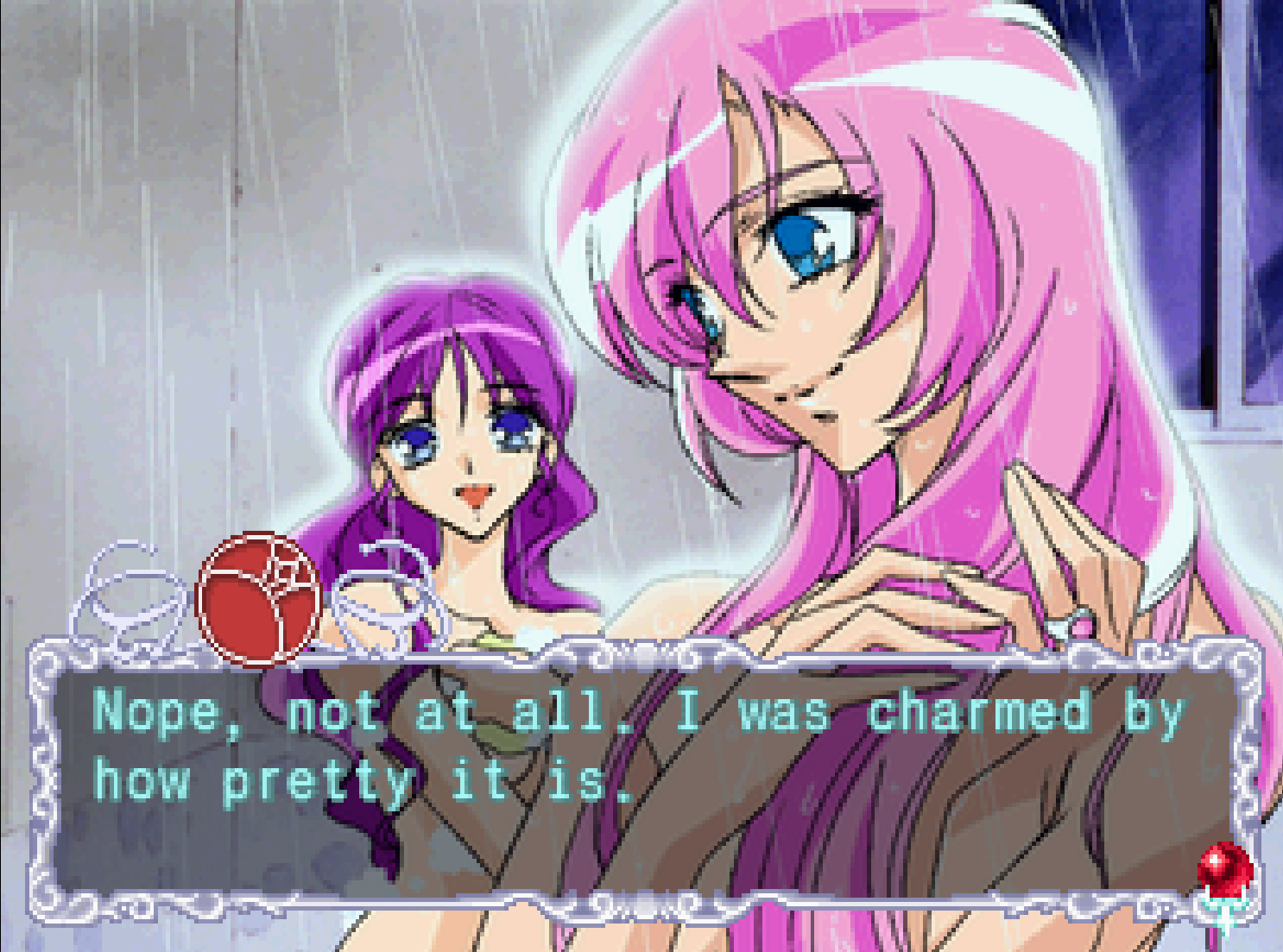
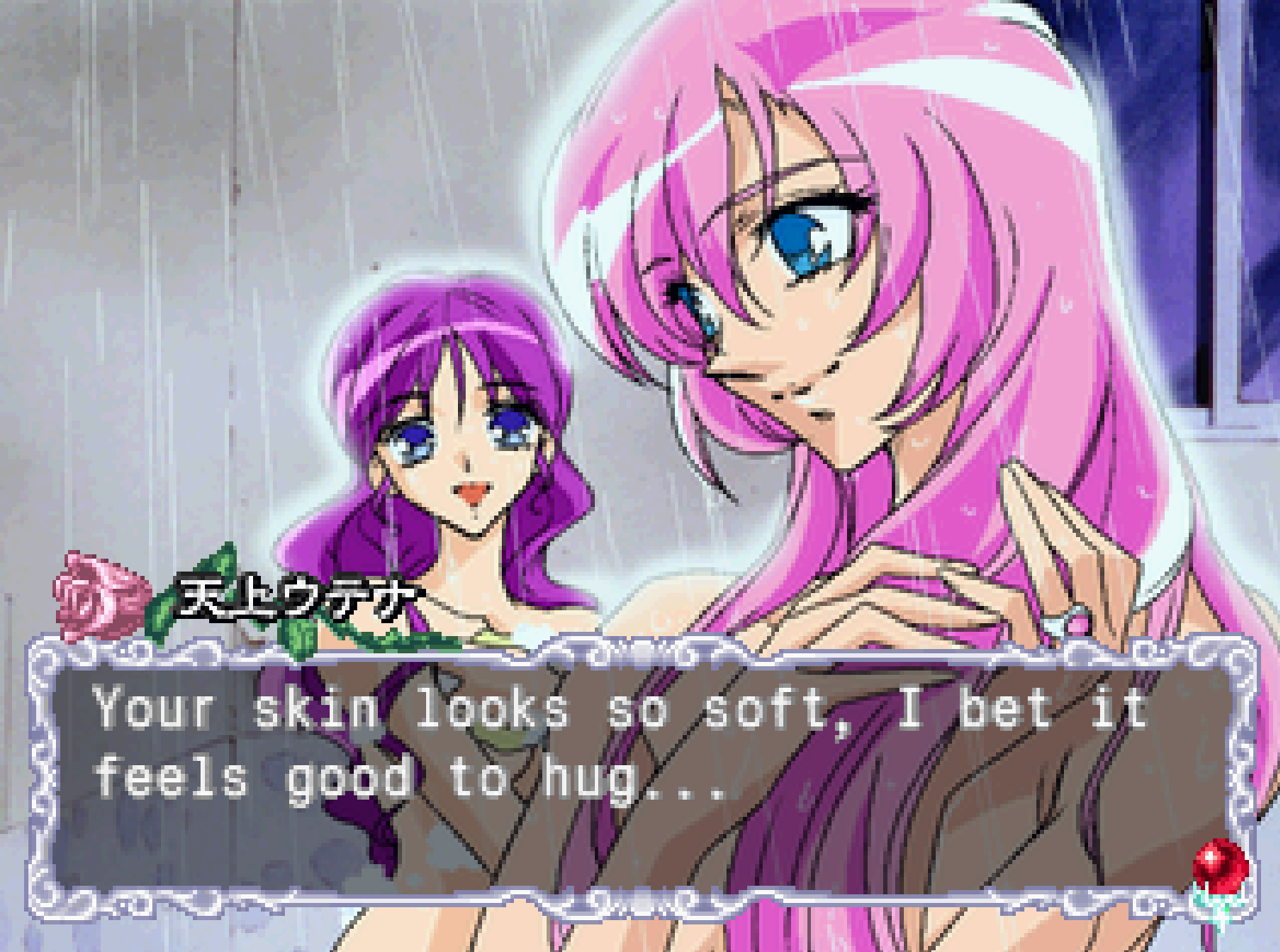
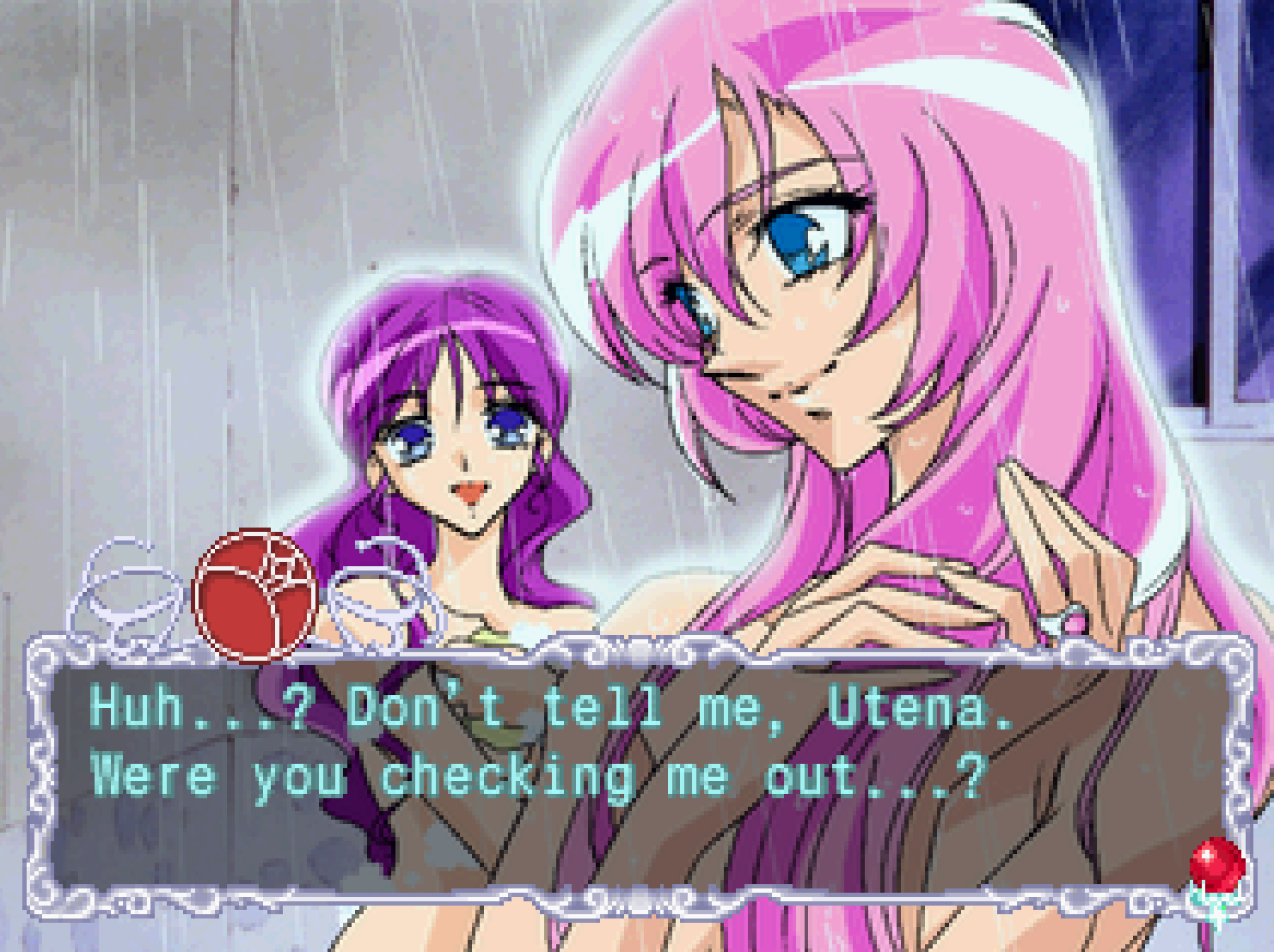
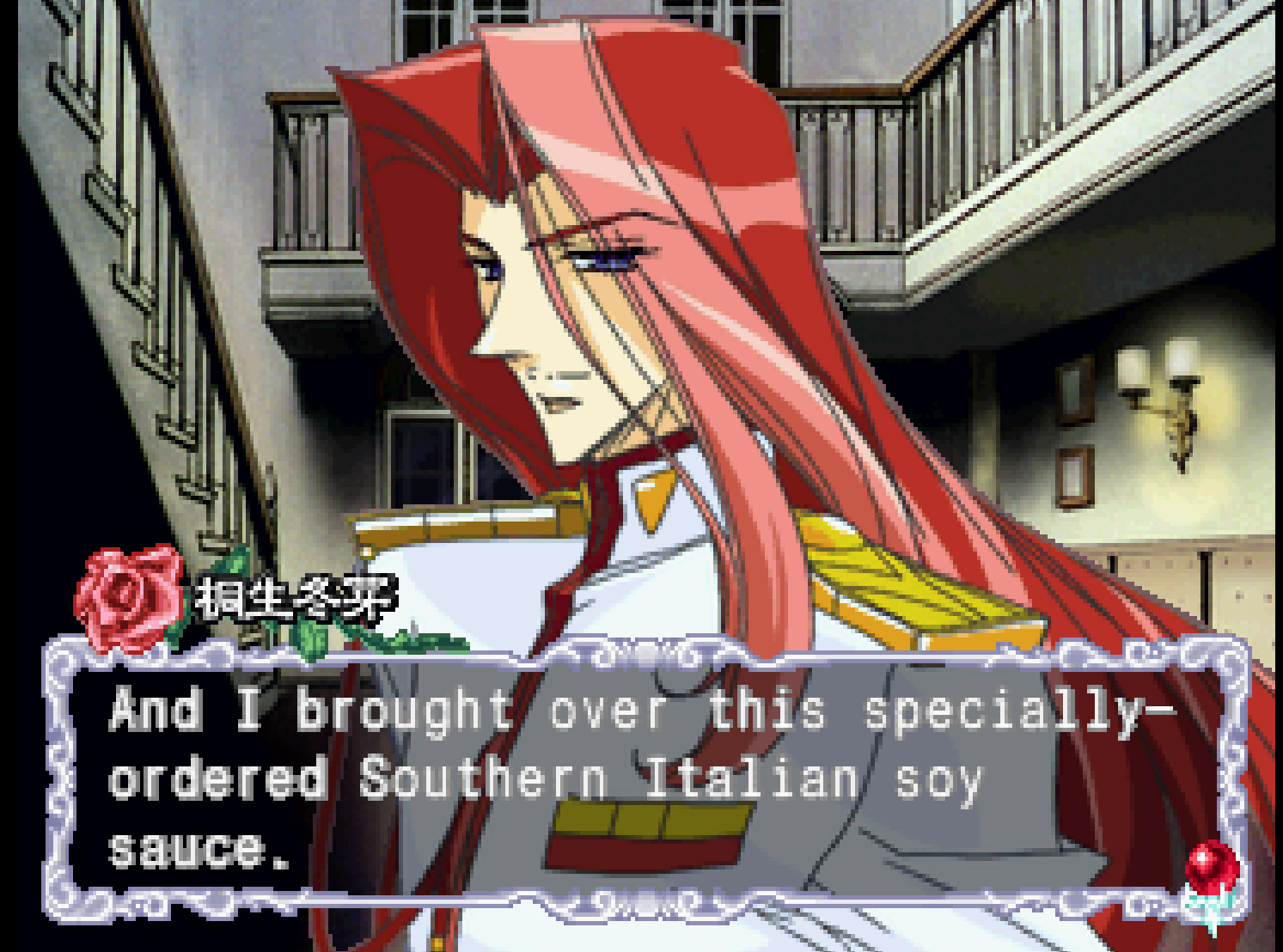
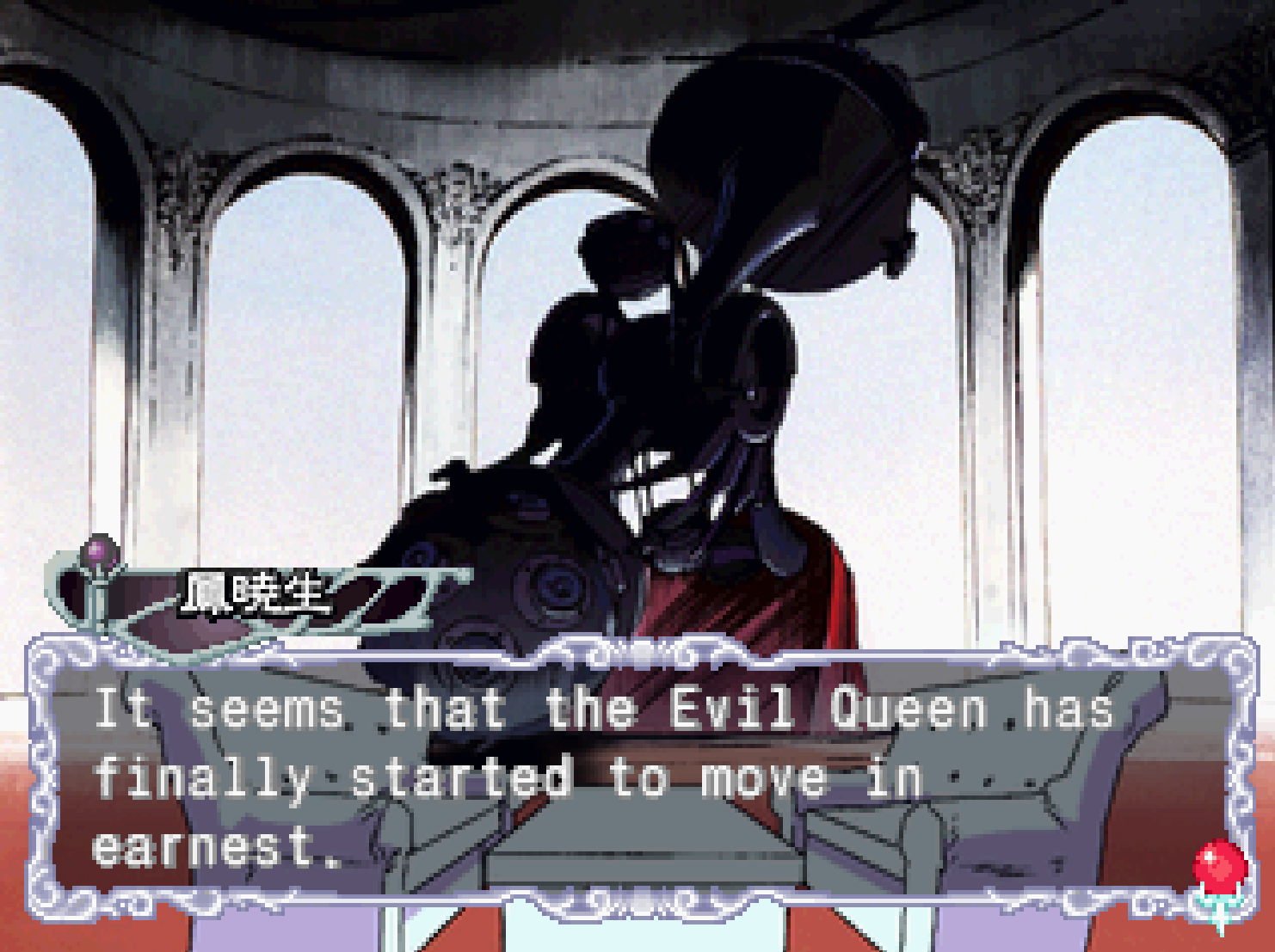
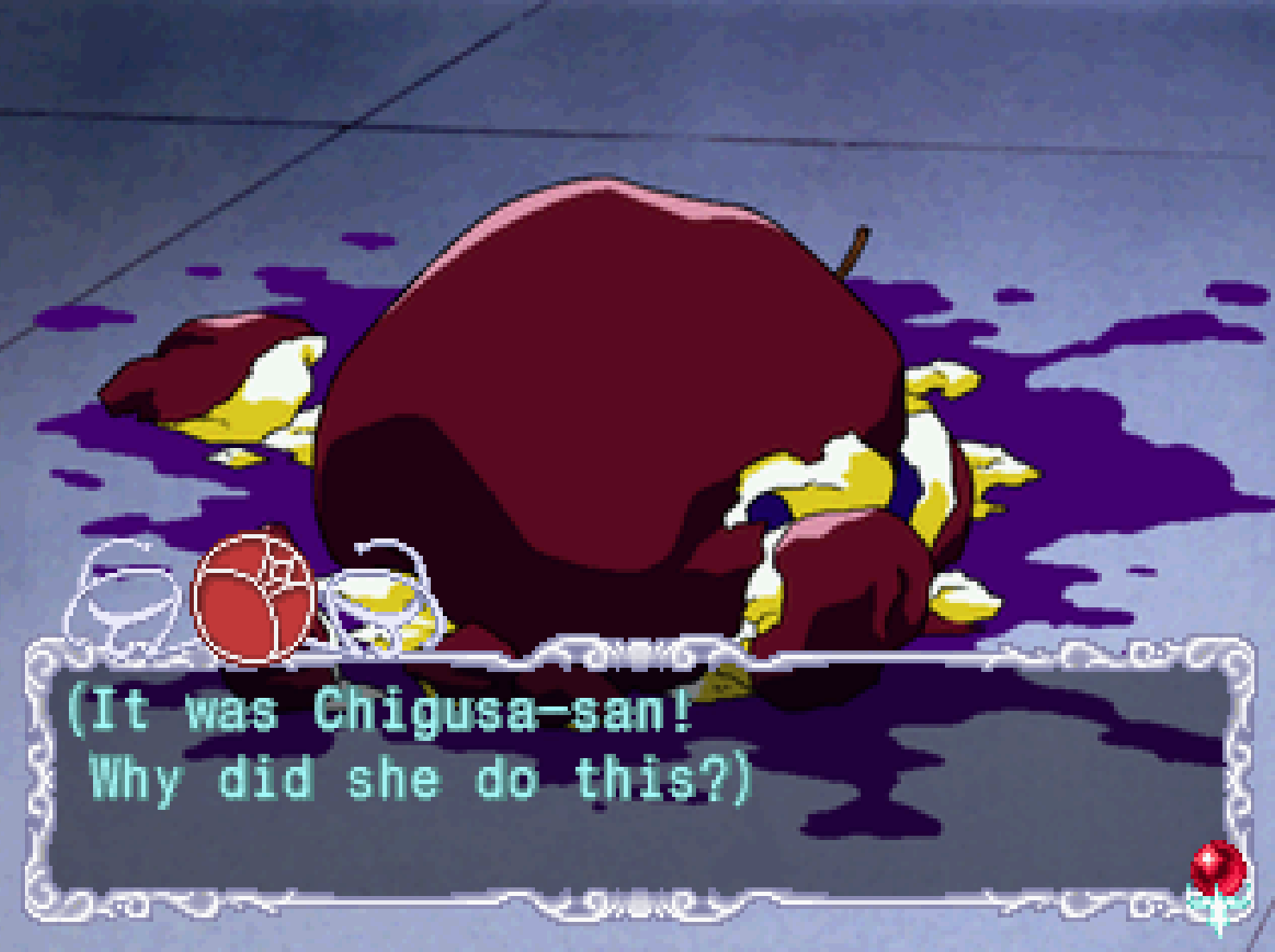
Chigusa is an enemy. Specifically, she is "the Evil Queen." When you ask her about her illness, she says that she accidentally ate the poison meant for Snow White, and she later leaves a poisoned apple with your name on it and a ripped picture of your mother. Akio calls her "the Evil Queen" in his scheming moments. Because she is evil, she tries to make you look stupid in class, tries to kill you during soccer, and you learn she's badmouthing you to people like Kozue. Behind the scenes, Chigusa is stealing away student council members and turning them against you, too.
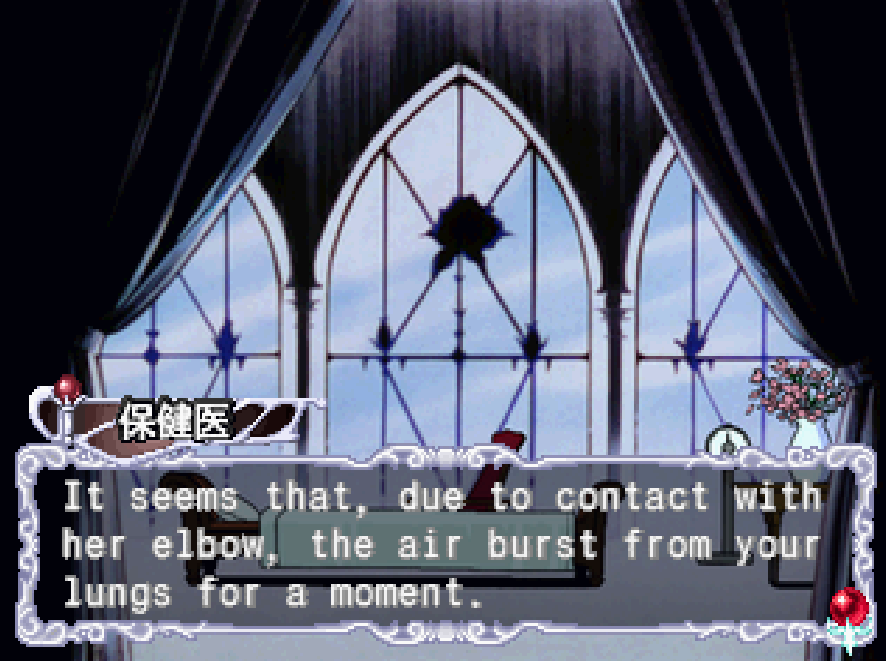
If you play your cards right, you can actually decide to duel Utena yourself.
With the Akio Car Ending, choosing to duel puts you in the car with Akio, and then you lose. If you fail to make any friends, you can get the Black Rose ending and become a Black Rose duelist.... and also lose. After all, you have no idea what you're doing. You maybe fenced, like, twice. Credits roll. In the secret Anthy ending, you Win the duel because Anthy replaces Utena's sword with a hammer. You can then have sex with Anthy, and then you lose the next duel to Utena. The Akio and Anthy endings left us mouth agape.

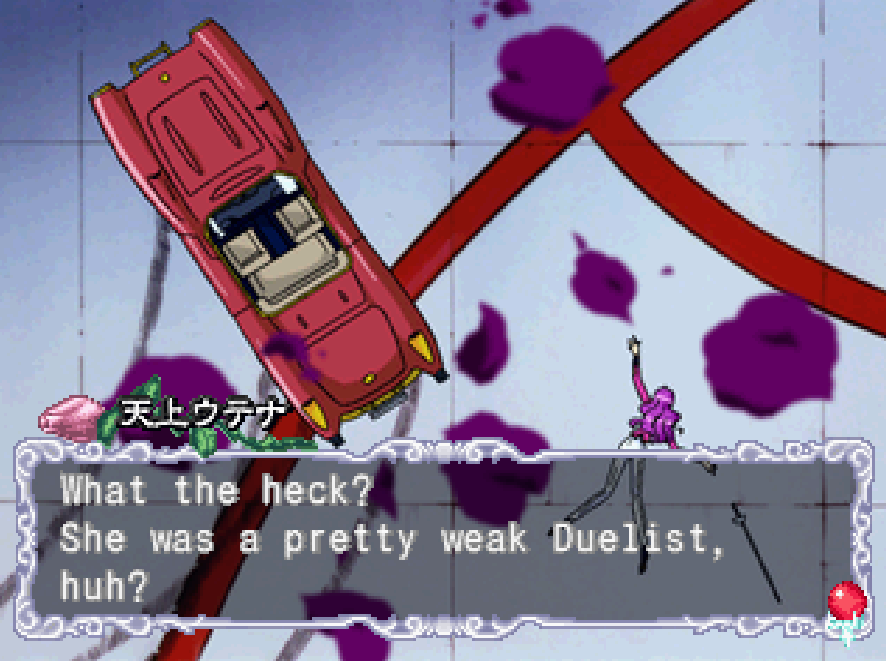
Eventually, you learn more about Chigusa and what she's doing. It turns out that she was a student at Ohtori fifteen years ago with your mother, who was her friend. She had a huge crush on the club advisor, your father, who was a teacher at the time. In a fencing practice fight, she went too far and hurt your mother, which resulted in your father calling her a "heartless girl," which devastated her. Shortly after, your parents were kicked out of school because a teacher shouldn't be in a relationship with a student, and they invited Chigusa to their wedding on the 25th. Instead of attending, Chigusa burned down the old fencing hall while she was still inside. Now, Chigusa wants the power to Revolutionize the World and rewrite that history, which is why you'll disappear if she wins the duel. After revealing her plot, she goes to the duel, locking you under the old fencing hall.
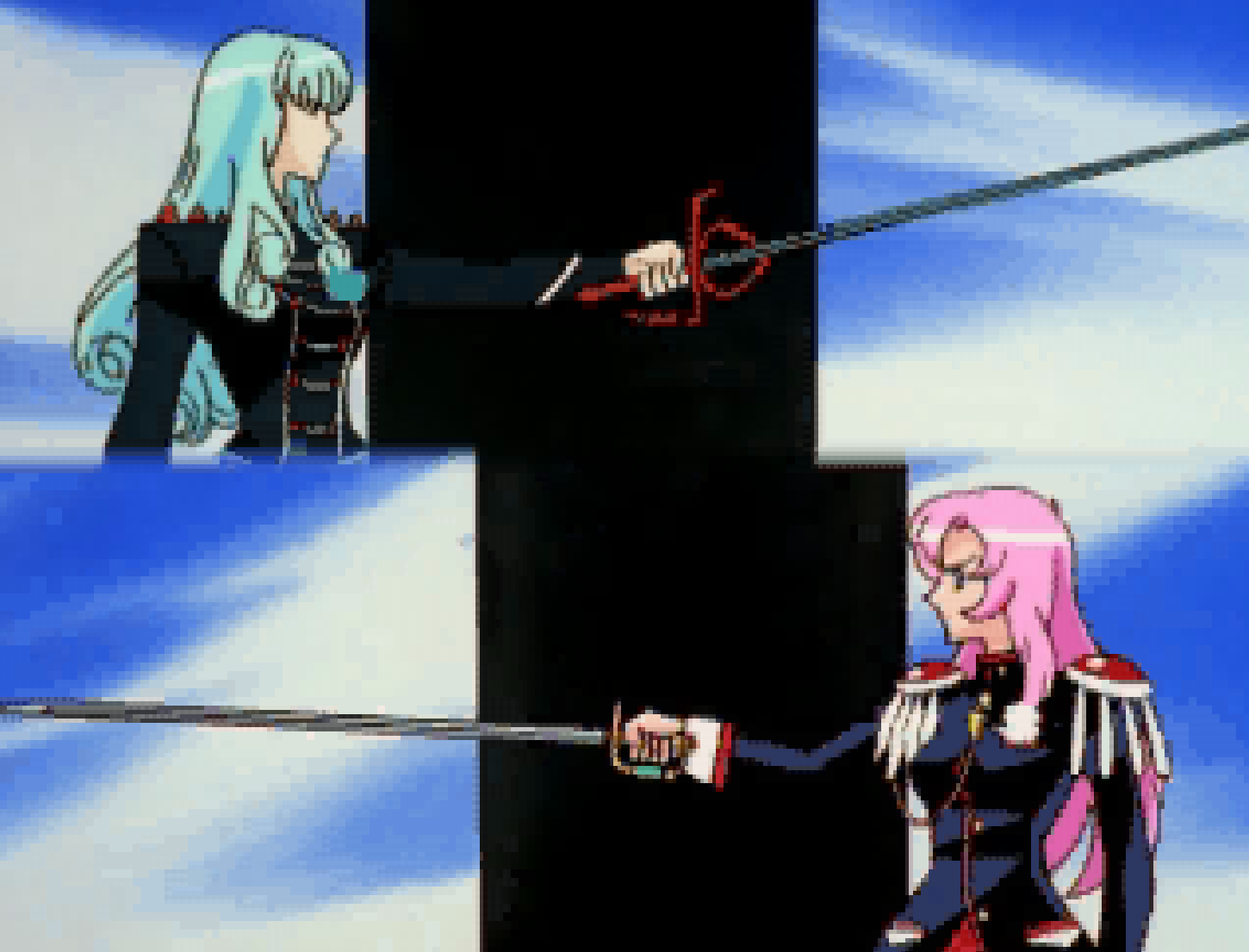
Any student council members who fell to Chigusa are brainwashed and try to kill you!
But a student council member or Chu-Chu can save you!
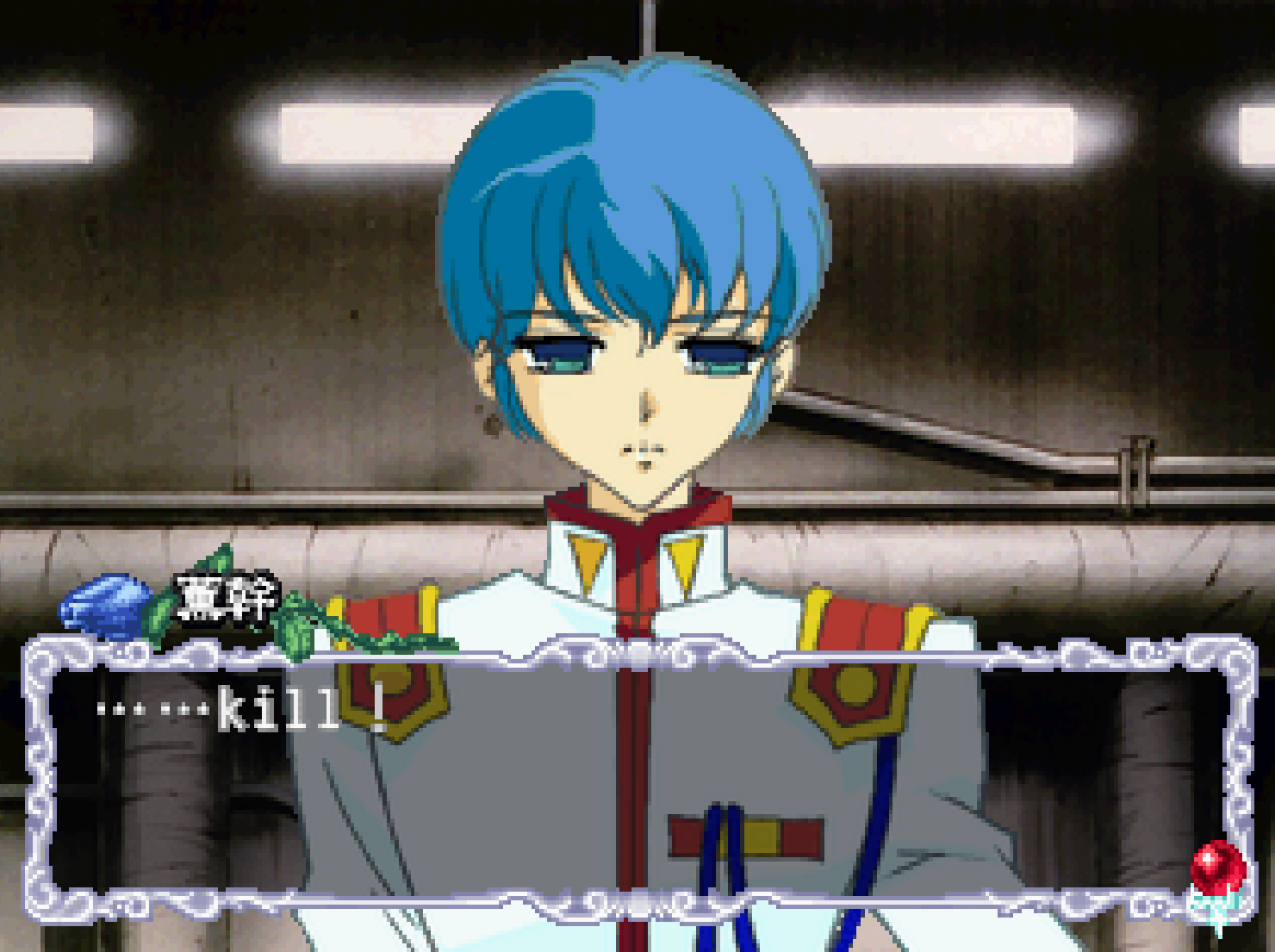
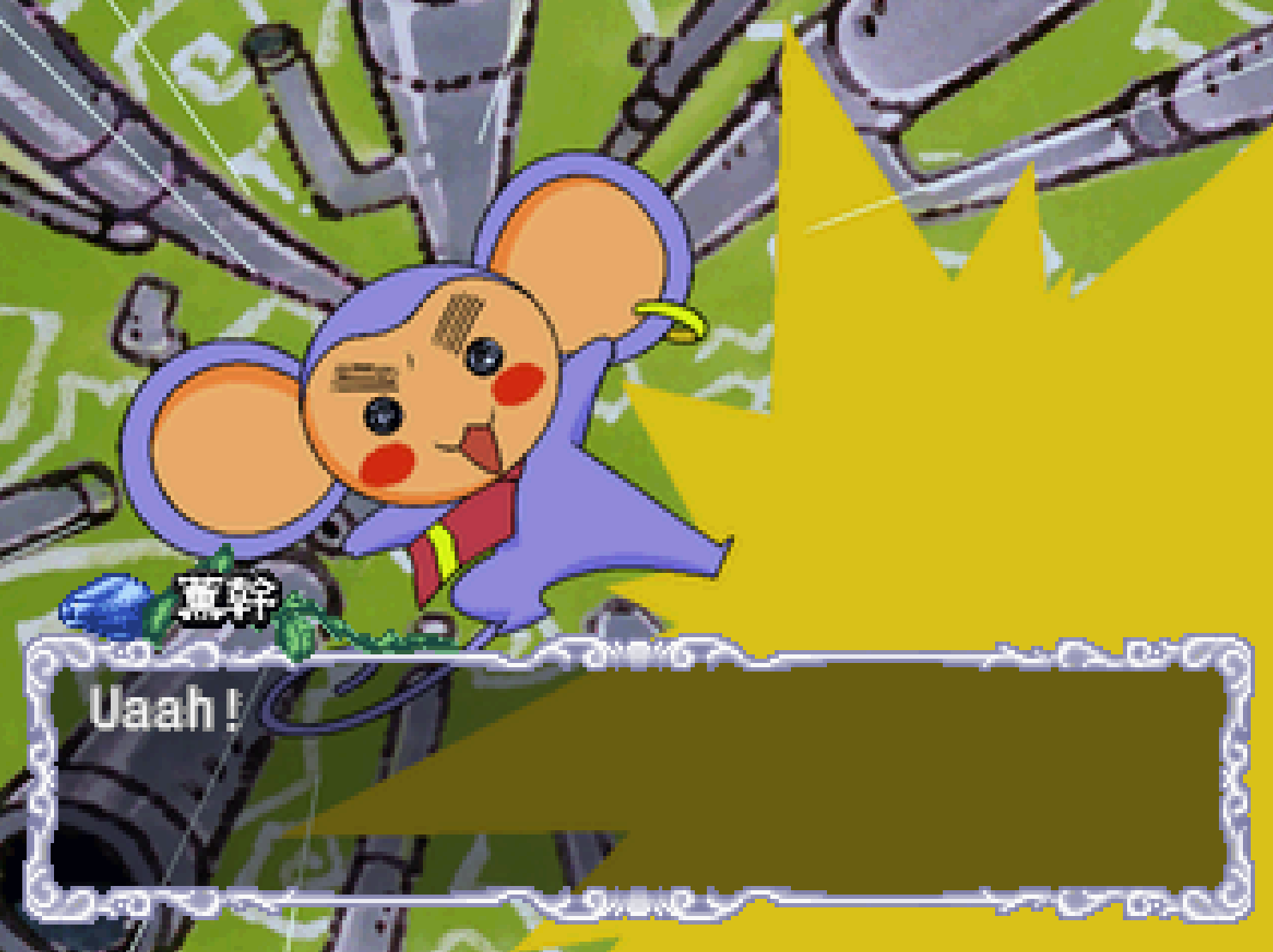
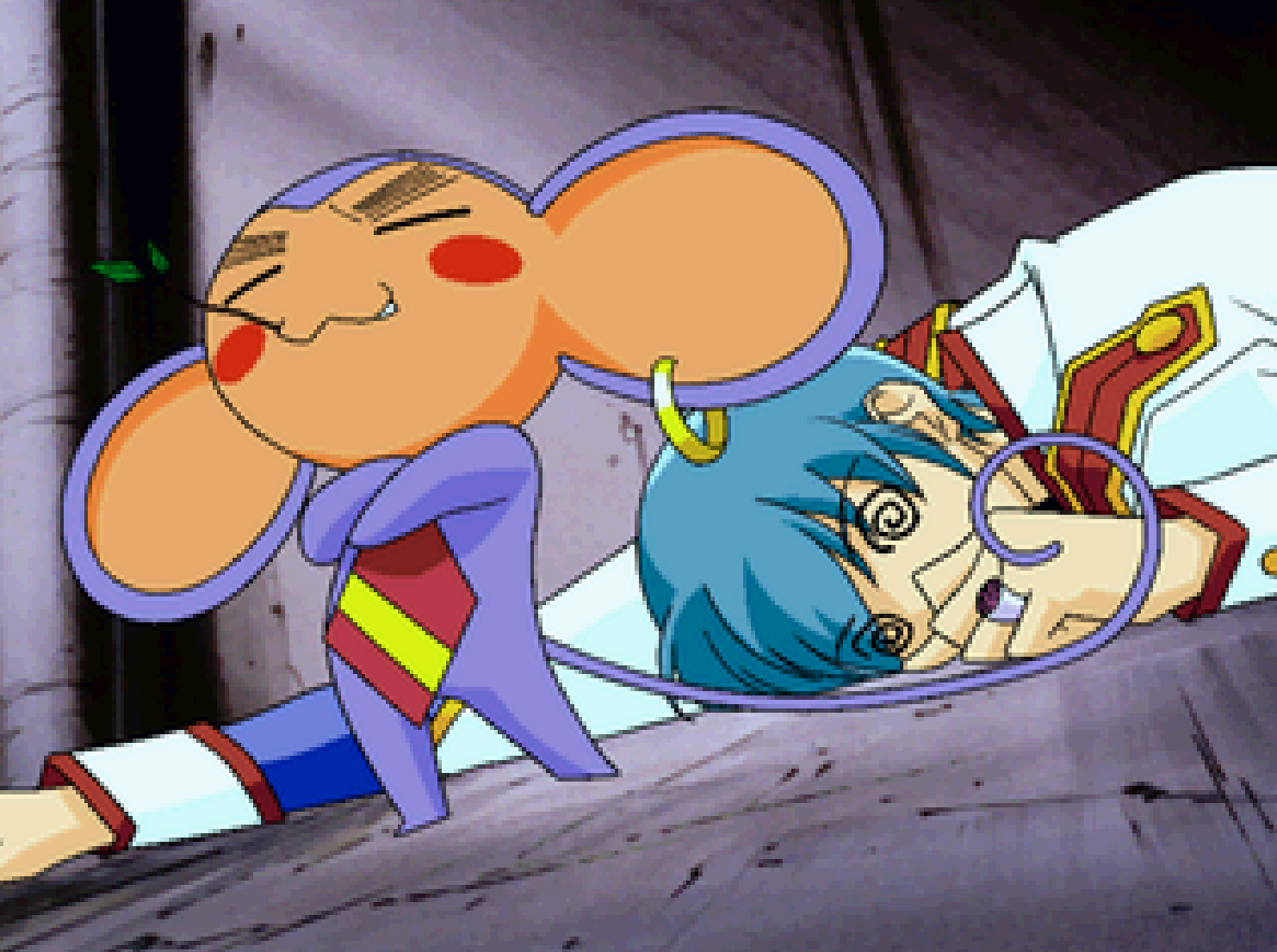
You need to stop Chigusa, but how? You run upstairs and into the old fencing hall locker room. You find your father's fencing club name tag tied up in red string in Chigusa's locker, the yorishiro binding her spirit to this world. Destroying it causes Chigusa to falter, giving Utena the chance to win the duel.
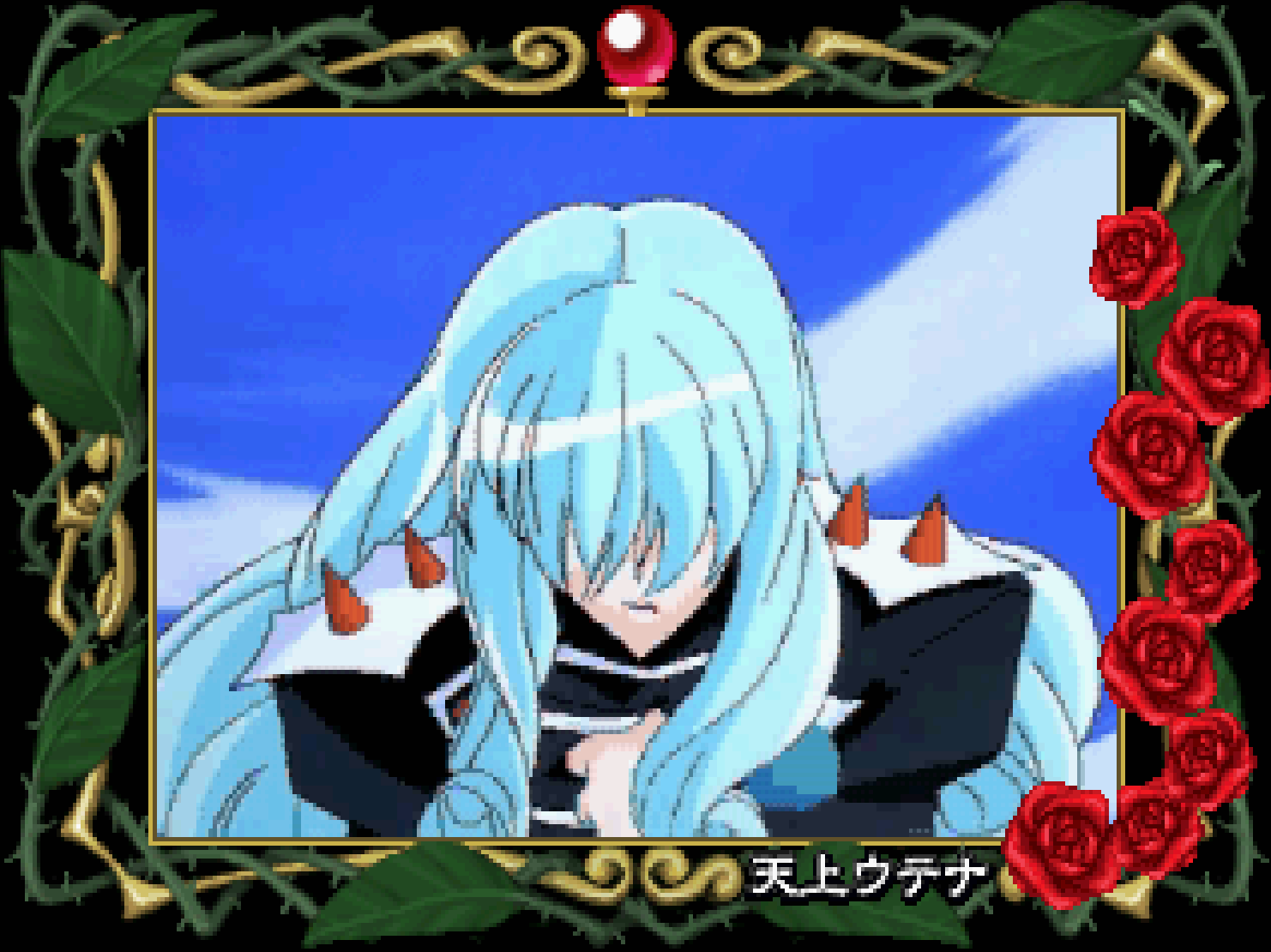
If Chigusa loses, then you get an ending credits scene, often involving kissing someone, before you transfer schools.
Utena ending spoilers
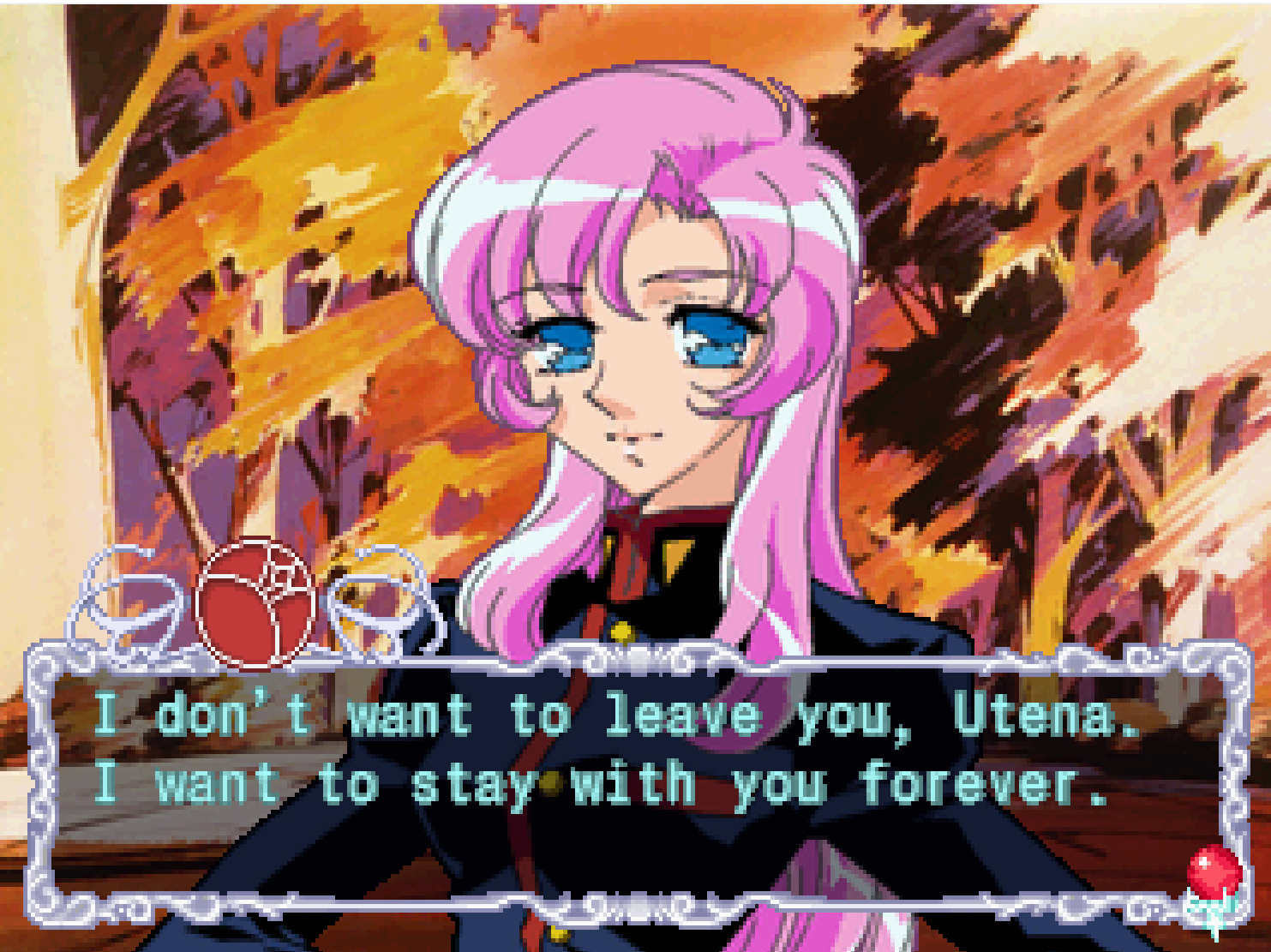
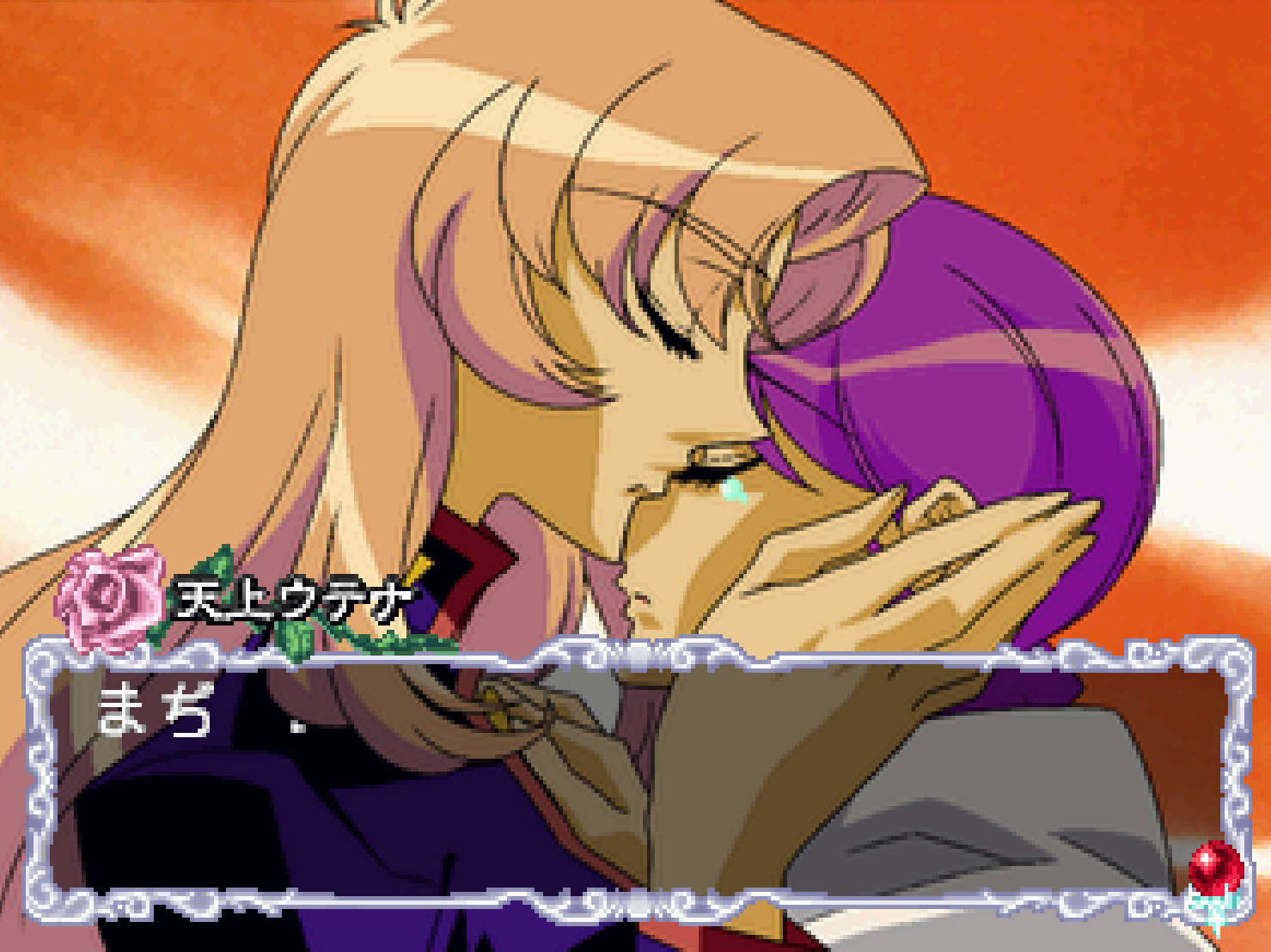
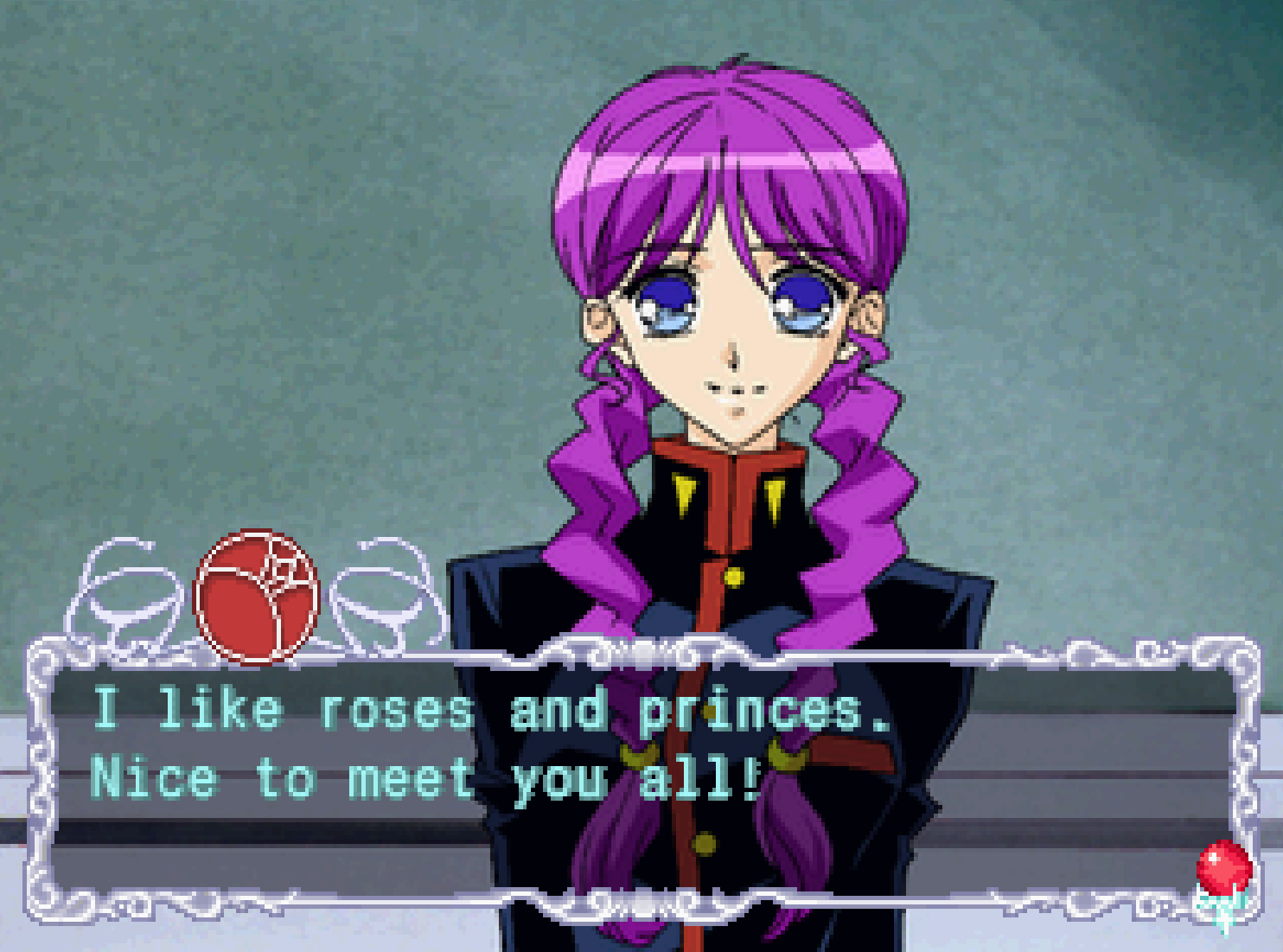
But then... you get the Reveal. Akio, talking to an off-screen Anthy, reveals the reason Chigusa was there at all: an attempt at spirit manifestation that is later employed in the Black Rose arc of the show.
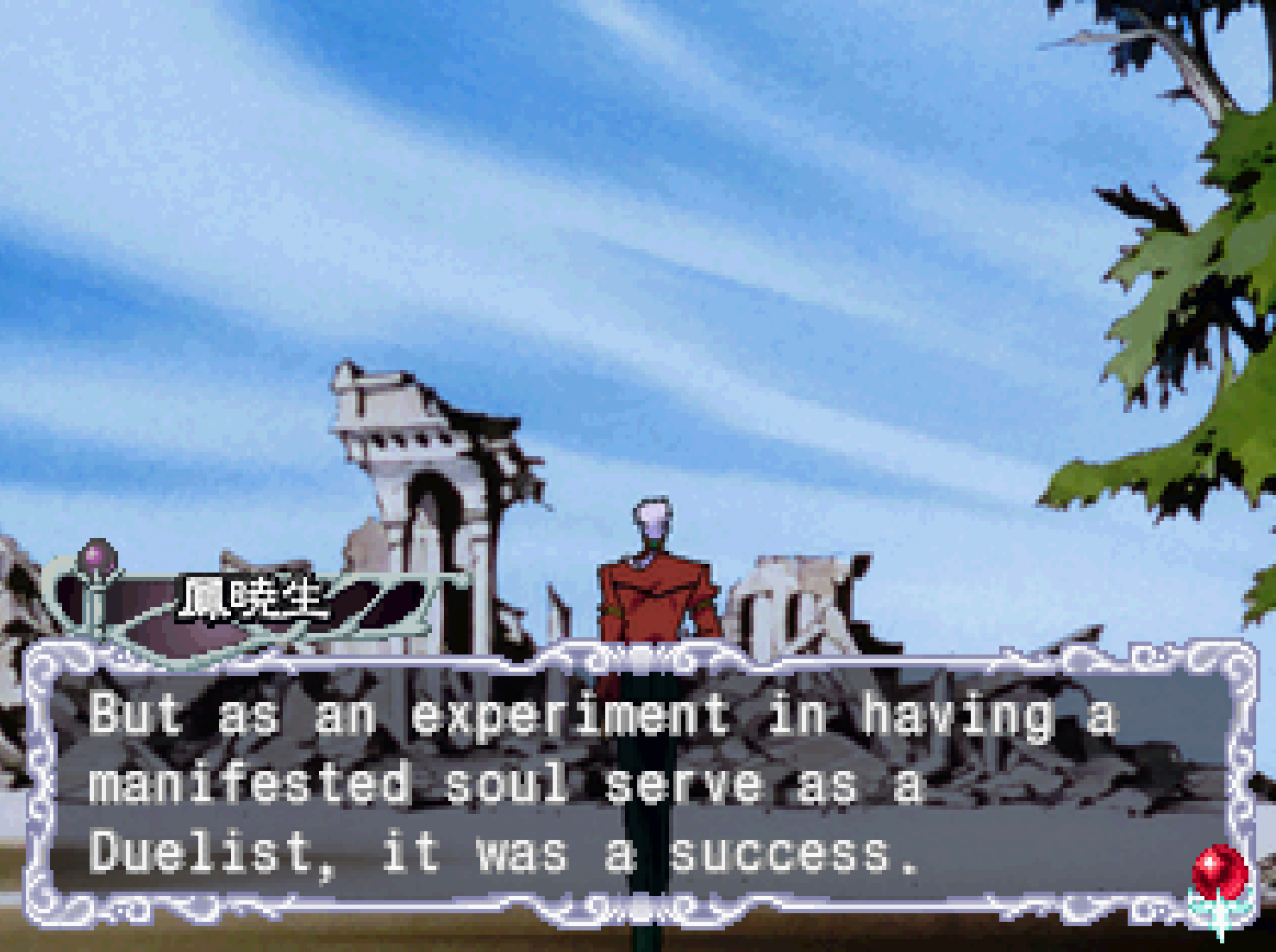
How dramatic! How exciting!
What a game.
Chigusa/Kozue
Chigusa wants to destroy you because you're a symbol of her failure to obtain your father as a lover. But some of the things she does are a bit strange! Feeding you bad answers in math to make you sound stupid is one thing, and even the more explicitly violent things like trying to kill you during a soccer game or make you swallow tacks is another, but dating Kozue just to badmouth you is something else.
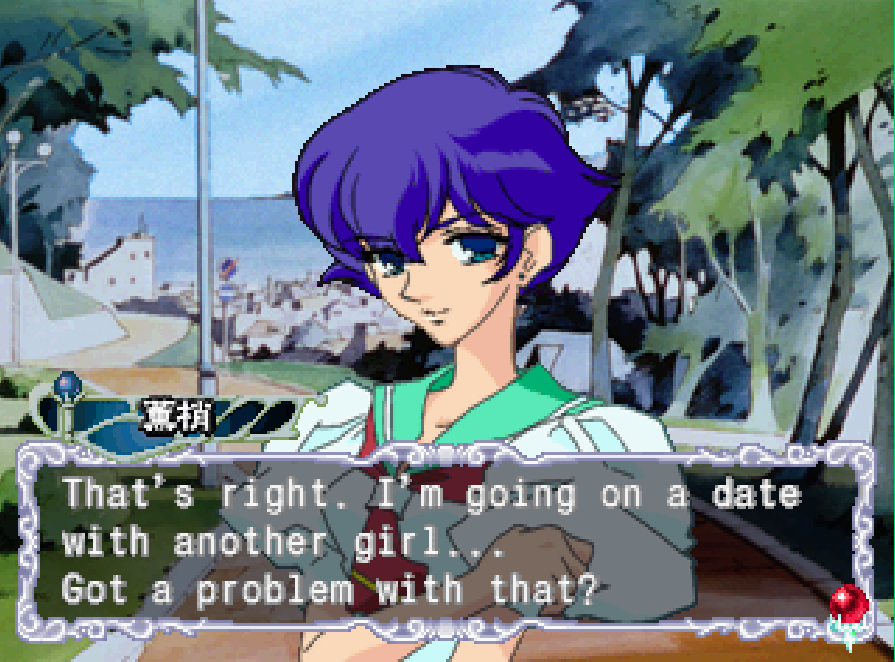
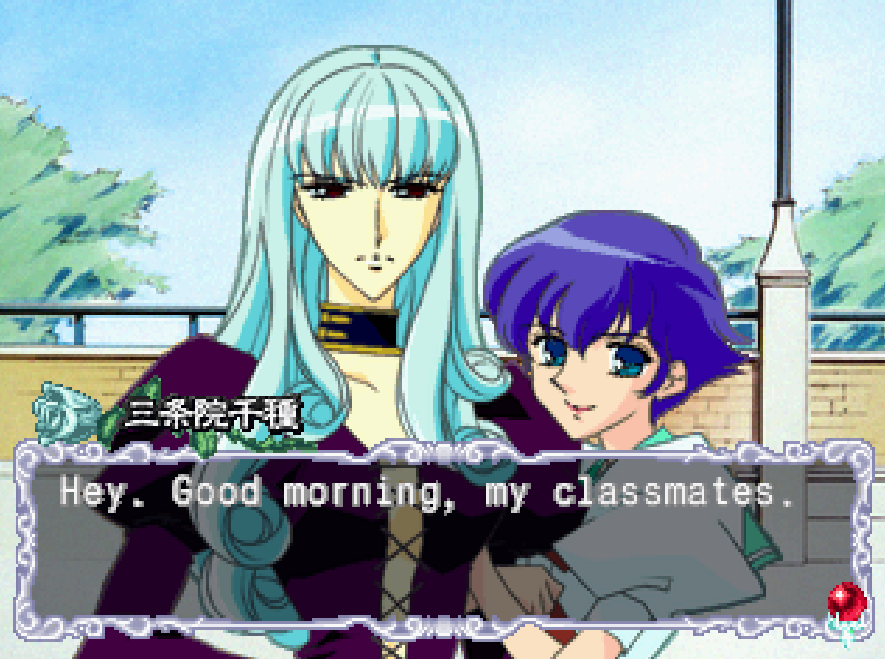
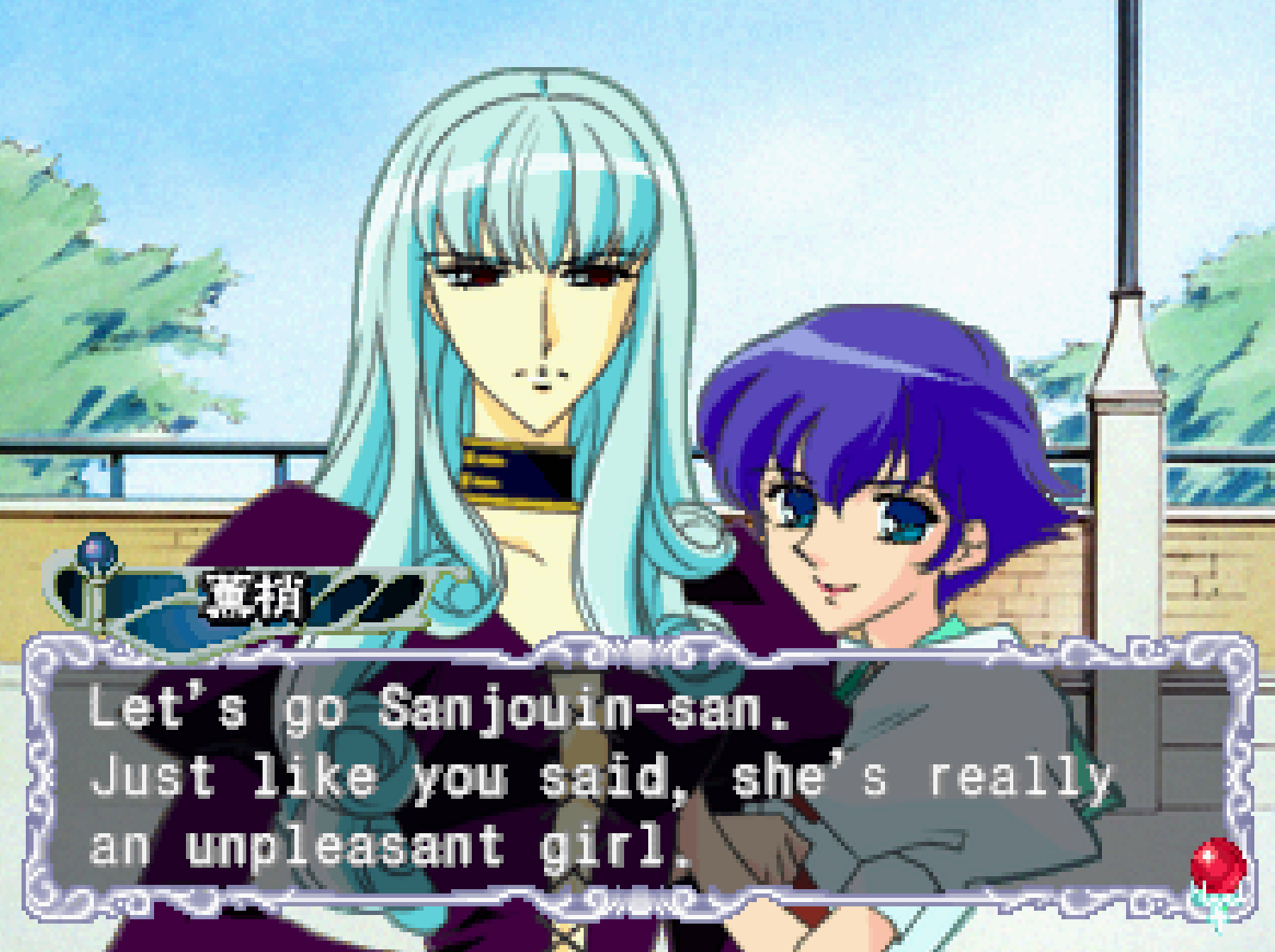
Chigusa's plot-relevant crush is on Touga, and if you choose certain options she can end up looking like she's dating him, but for most playthroughs Chigusa and Kozue are together most of the time, arm in arm, even late at night by themselves in an abandoned building. What a bold shipping choice.
Gameplay
The game is a visual novel with relationship meters measured in "Nobility Points." Depending on what activities you do and how you interact with Utena, Anthy, and the various student council members, you can unlock different scenes with them.
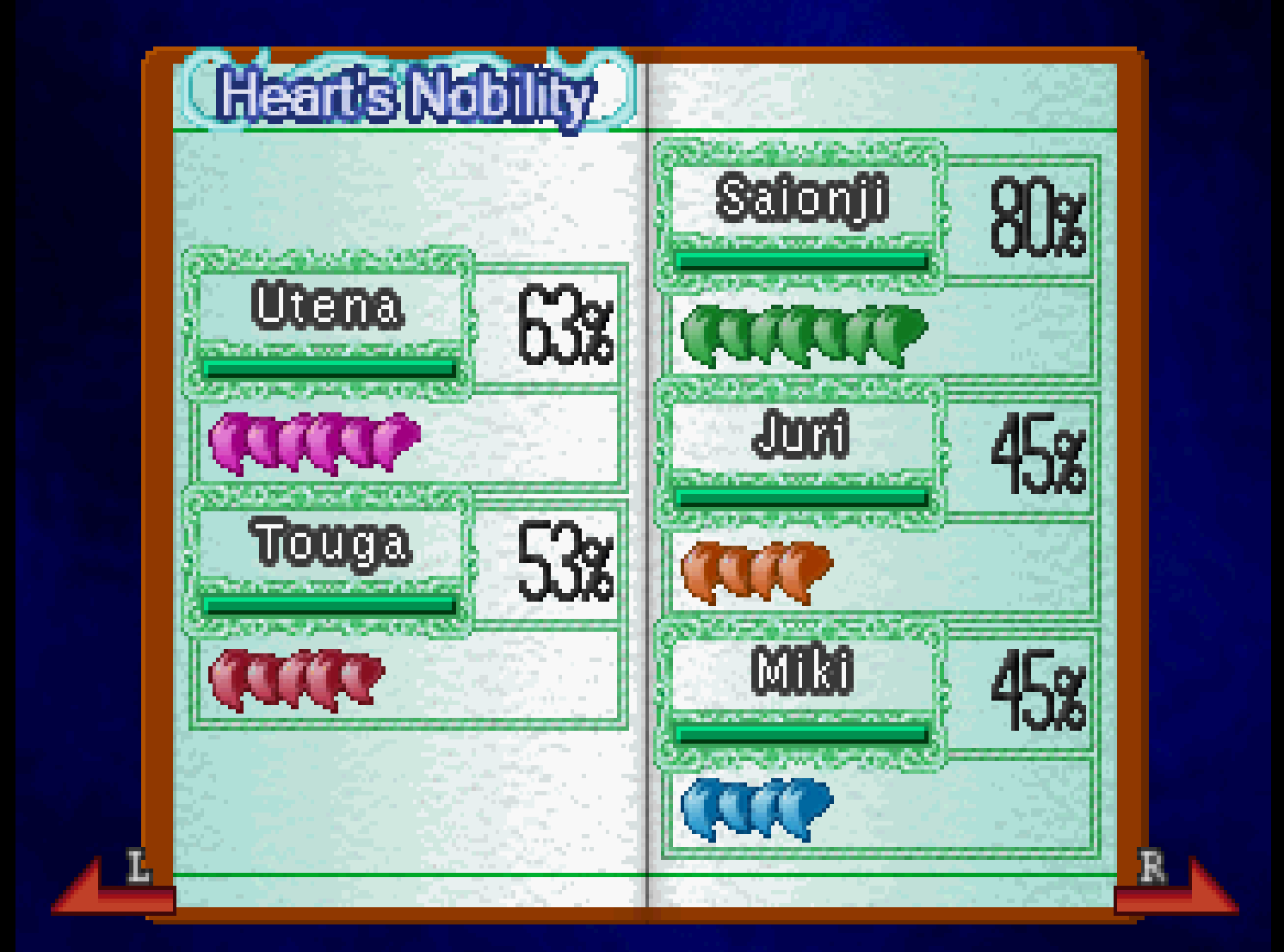
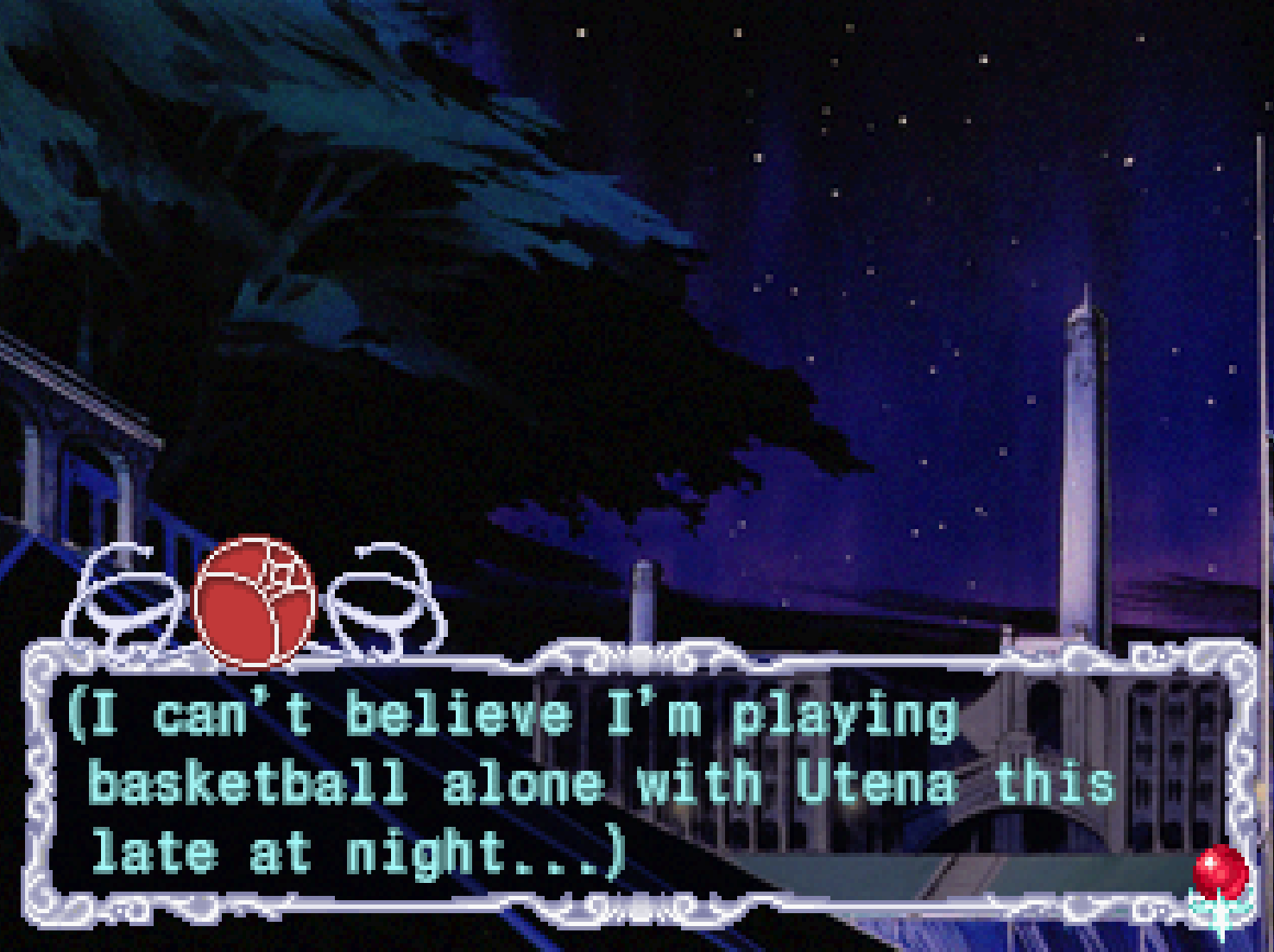
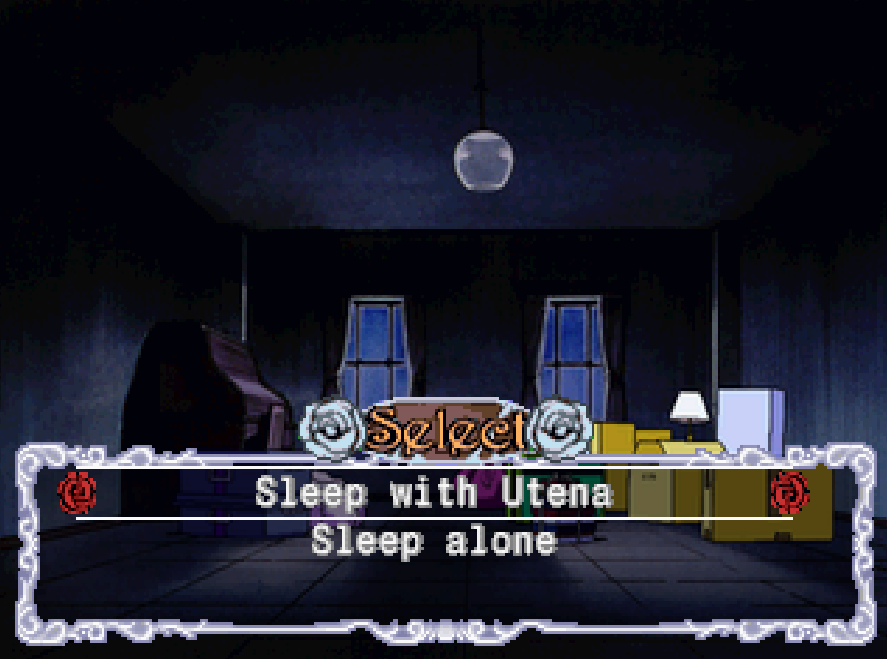
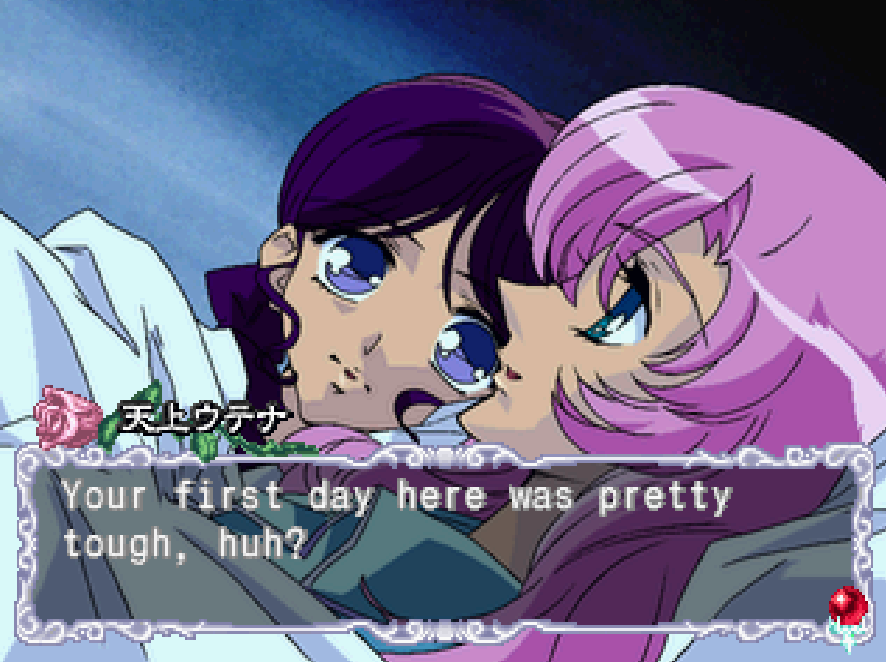
The explicit romance varies depending on your preferred student council member, but you can shower with girls and comment on their beautiful bodies. For example. You can sleep in Utena's bed. Platonically. Or Touga's, eventually. Sexually.
Touga with his shirt undone
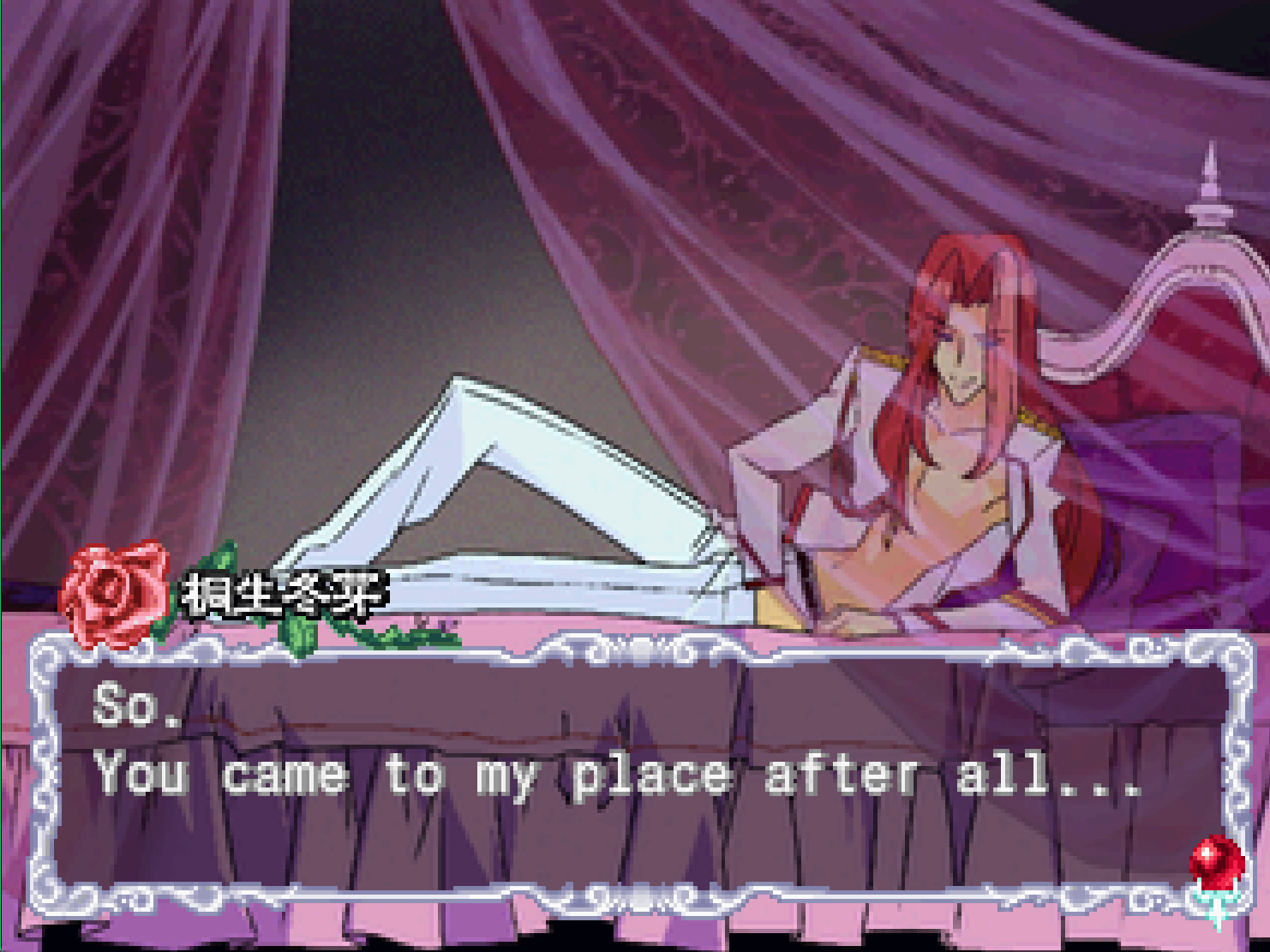
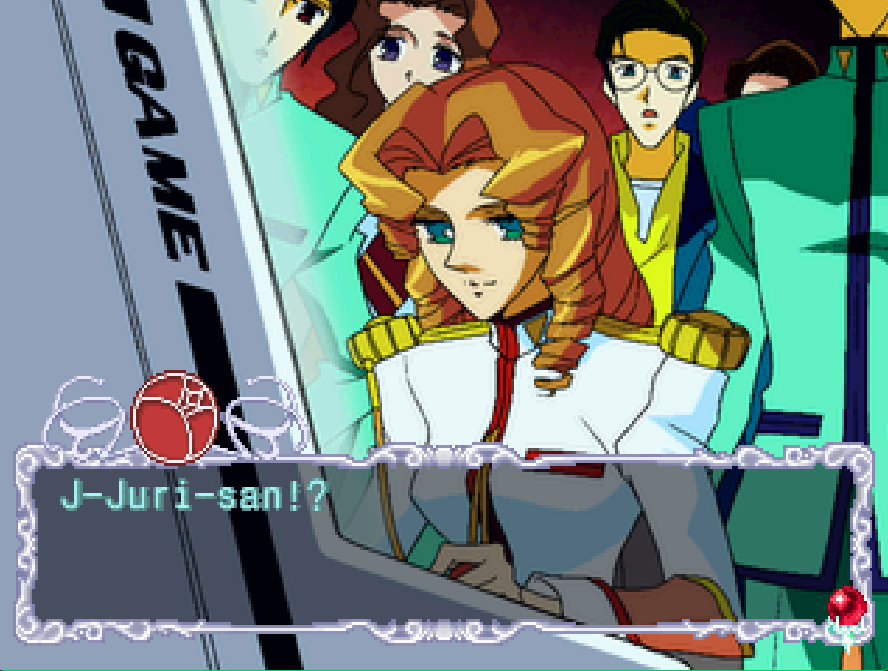
It's a bit esoteric who's where in the overworld when you have to choose which place to go to, but if you ask Wakaba about a character she'll tell you. Utena mentions going out for tea later, and at first we thought that meant she was going to the tea room. Instead, Saionji was there drinking Japanese tea and complaining that other people just don't get Japanese tea. He's a lover of kendo, a Japanese martial art, but there isn't anything that explicitly anywhere in canon says he'd be a fan of Japanese tea.
As we mentioned earlier, but it's Juri who's at the arcade. And she's pwning noobs.
There are multiple ways to get an early game over. Simply choosing the same character over and over doesn't necessarily mean that you'll earn enough points to win. For example, if you maximize Touga's points at every opportunity, you can lose points with Utena, so you can't actually get the Touga ending.
There are so many different endings! Luckily the game isn't that long, only about three hours, but it's still an investment if you want to play through and get them all. YouTuber Nene Hates has playthroughs with all the endings, if you'd rather just watch.
Why is Chigusa's face here?
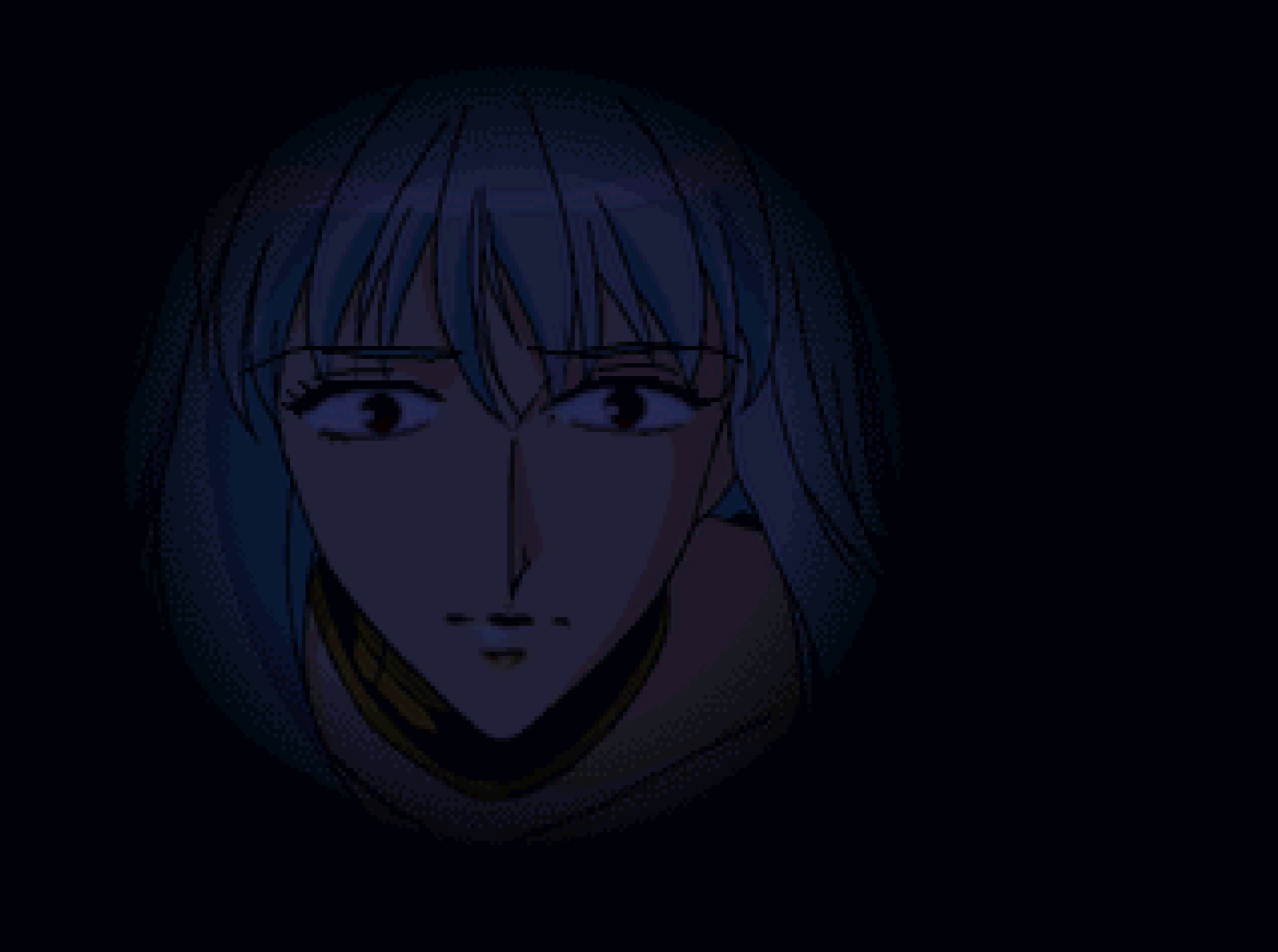
Something that was extremely baffling was when, multiple times a playthrough, Chigusa's smug face appeared after certain scenes and roses were subtracted from the various characters' meters.
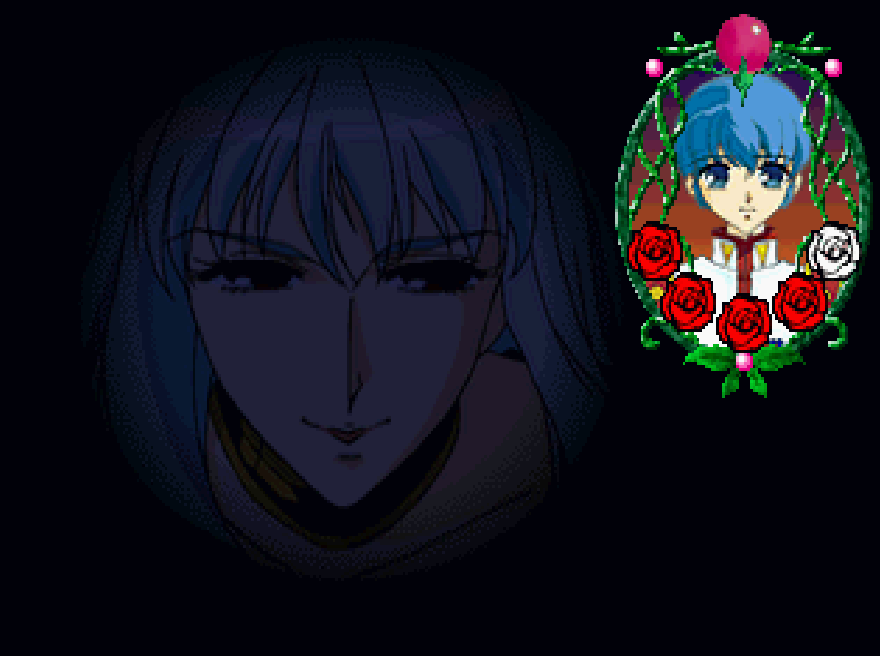
This is her special move: Nobility Point Slash! If you interact with her, you enable her to steal your relationships with other characters! You need certain levels of friendship to unlock scenes, so if you let her steal enough points you won't get them. At first, we thought that it was showing Chigusa's friendship loss with them because of things like "acting out personal conflicts through fencing" or "trying to kill the new girl." But no, she's stealing YOUR points. How cruel! After realizing this, and looking up a guide for how to get certain endings, we got to see times where Chigusa's consternated face appears and 0 roses are removed from anyone's meters.
Emulation
We used RetroArch. Note to anyone considering playing this game: use the Beetle Saturn core!!! This game has two discs, and this specific game has problems with other cores in the disc swapping process. We were using Kronos and ended up having to replay the first disc three extra times. If you're using the Beetle Saturn core, you may have to specifically add a Saturn BIOS with the file name "sega_101.bin". You can just copy the existing Japanese BIOs that you can get in RetroArch and rename it "sega_101.bin".
The game is only in Japanese, but there is a fan translation that we used. The download gives you the two .cue files and the .bin files you need, but you can make the disc swapping process easier by making a .m3u file. Just open up Notepad or the equivalent and enter the names of the .cue files one after another, then save it as a .m3u file with whatever name you want. Just make sure that it's not secretly saving it as NAME.m3u.txt or something.
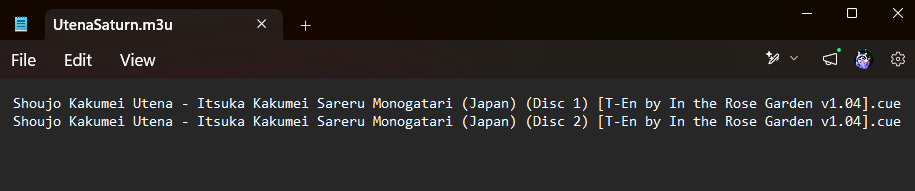
Then, when you go to load the content, select the .m3u file instead of the .cue files. When the time comes, you can toggle the disc eject, choose "Next Disc," and toggle the disc eject again to load the new disc.
We used save states before certain decisions to let us try both options of something, but you can also use the game's System RAM save points along the way to make sure you don't lose progress. They'll save in your RetroArch saves folder with the name of the content file .srm, and you can open the save in the game's loading screen.
The only other problem besides the disc swapping was that the audio, especially during cinematics, got extremely crunchy. That we couldn't figure how to fix... Good luck if you try it yourself!
External Links
Source material
Fan sites
- ohtori.nu: fan analyses, vector traces, song lyrics, translated creator interviews, doujinshi, and so so so much more. The graphic design of some of the sub-sites is truly incredible (like this one, and this one, and this one). You MUST check them out.
- Something Eternal: Utena forums and picture galleries, run by the people who maintain ohtori.nu
Fanzines
- Duelist Couture: fashion-themed Utena fanzine featuring tons of art and cosplay from different artists
- Confessional Theater: Black Rose saga fanzine featuring art, essays, and fanfiction
- Absolute Destiny Post-Apocalypse: fanzine featuring art and fanfiction of characters after the events of the series
- Hidden Face: fanzine featuring art and fanfiction of Juri and Shiori and their complicated relationship